
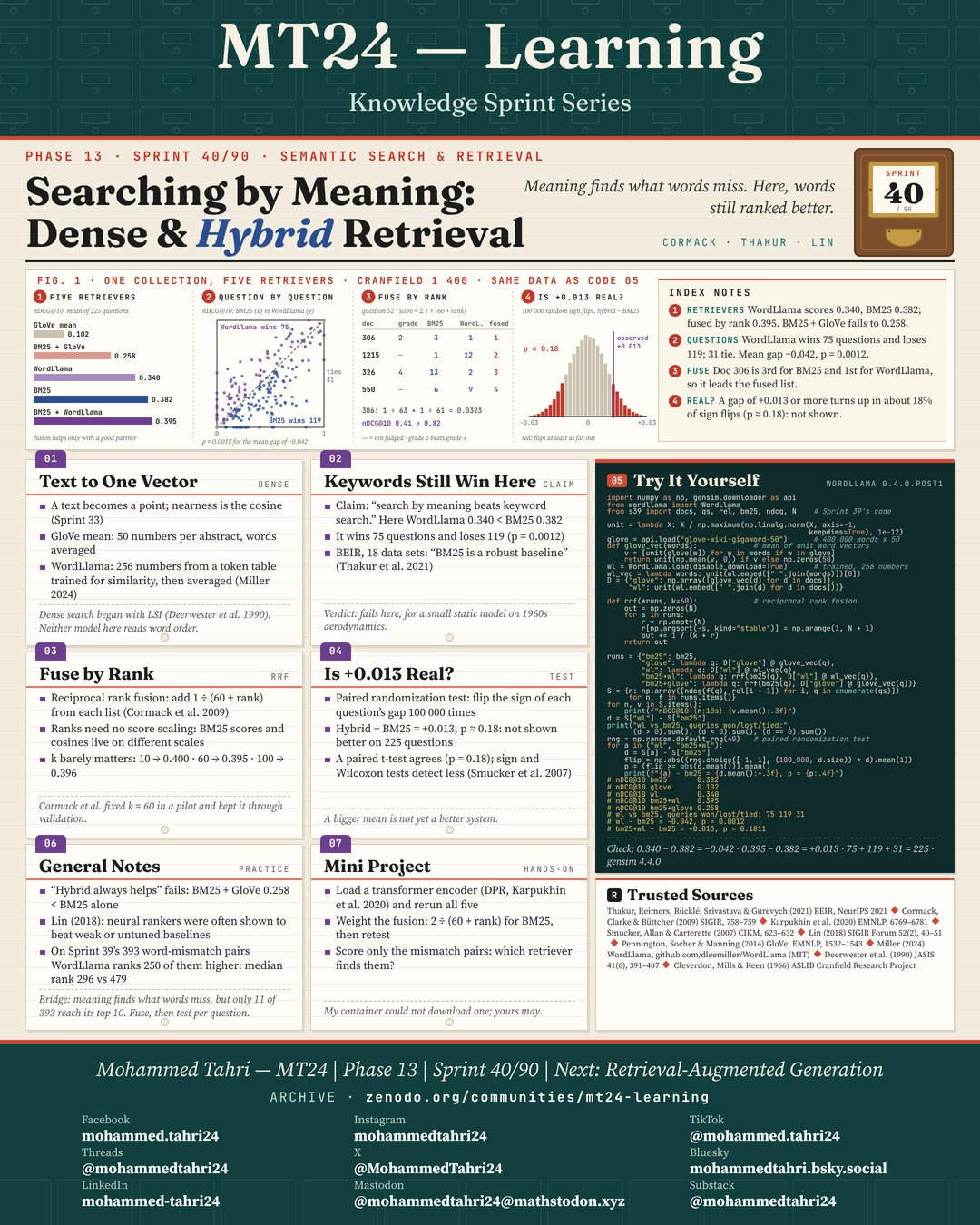

Fig. 1 in words
One collection, five retrievers · Cranfield 1 400 · same data as code 05
1 Five retrievers
- nDCG@10, mean of 225 questions
- GloVe mean 0.102 · BM25 + GloVe 0.258 · WordLlama 0.340 · BM25 0.382 · BM25 + WordLlama 0.395
- fusion helps only with a good partner
2 Question by question
- nDCG@10: BM25 (x) vs WordLlama (y), 0 to 1
- WordLlama wins 75 · BM25 wins 119 · ties 31
- p = 0.0012 for the mean gap of −0.042
3 Fuse by rank
- question 52 · score = Σ 1 ÷ (60 + rank)
- doc · grade · BM25 · WordL. · fused
- 306 · 2 · 3 · 1 · 1
- 1215 · — · 1 · 12 · 2
- 326 · 4 · 13 · 2 · 3
- 550 · — · 6 · 9 · 4
- 306: 1 ÷ 63 + 1 ÷ 61 = 0.0323
- nDCG@10 0.41 → 0.82
- — = not judged · grade 2 beats grade 4
4 Is +0.013 real?
- 100 000 random sign flips, hybrid − BM25
- observed +0.013 · p ≈ 0.18 · axis -0.03 to +0.03
- red: flips at least as far out
01 Text to One Vector Dense
- A text becomes a point; nearness is the cosine (Sprint 33)
- GloVe mean: 50 numbers per abstract, words averaged
- WordLlama: 256 numbers from a token table trained for similarity, then averaged (Miller 2024)
Dense search began with LSI (Deerwester et al. 1990). Neither model here reads word order.
02 Keywords Still Win Here Claim
- Claim: “search by meaning beats keyword search.” Here WordLlama 0.340 < BM25 0.382
- It wins 75 questions and loses 119 (p = 0.0012)
- BEIR, 18 data sets: “BM25 is a robust baseline” (Thakur et al. 2021)
Verdict: fails here, for a small static model on 1960s aerodynamics.
03 Fuse by Rank RRF
- Reciprocal rank fusion: add 1 ÷ (60 + rank) from each list (Cormack et al. 2009)
- Ranks need no score scaling: BM25 scores and cosines live on different scales
- k barely matters: 10 → 0.400 · 60 → 0.395 · 100 → 0.396
Cormack et al. fixed k = 60 in a pilot and kept it through validation.
04 Is +0.013 Real? Test
- Paired randomization test: flip the sign of each question’s gap 100 000 times
- Hybrid − BM25 = +0.013, p ≈ 0.18: not shown better on 225 questions
- A paired t-test agrees (p = 0.18); sign and Wilcoxon tests detect less (Smucker et al. 2007)
A bigger mean is not yet a better system.
05 Try It Yourself WORDLLAMA 0.4.0.POST1
sprint40_searching_by_meaning_dense_hybrid_retrieval.py
import numpy as np, gensim.downloader as api
from wordllama import WordLlama
from s39 import docs, qs, rel, bm25, ndcg, N    # Sprint 39's code

unit = lambda X: X / np.maximum(np.linalg.norm(X, axis=-1,
                                               keepdims=True), 1e-12)
glove = api.load("glove-wiki-gigaword-50")      # 400 000 words x 50
def glove_vec(words):             # mean of unit word vectors
    v = [unit(glove[w]) for w in words if w in glove]
    return unit(np.mean(v, 0)) if v else np.zeros(50)
wl = WordLlama.load(disable_download=True)      # trained, 256 numbers
wl_vec = lambda words: unit(wl.embed([" ".join(words)])[0])
D = {"glove": np.array([glove_vec(d) for d in docs]),
     "wl": unit(wl.embed([" ".join(d) for d in docs]))}

def rrf(*runs, k=60):             # reciprocal rank fusion
    out = np.zeros(N)
    for s in runs:
        r = np.empty(N)
        r[np.argsort(-s, kind="stable")] = np.arange(1, N + 1)
        out += 1 / (k + r)
    return out

runs = {"bm25": bm25,
        "glove": lambda q: D["glove"] @ glove_vec(q),
        "wl": lambda q: D["wl"] @ wl_vec(q),
        "bm25+wl": lambda q: rrf(bm25(q), D["wl"] @ wl_vec(q)),
        "bm25+glove": lambda q: rrf(bm25(q), D["glove"] @ glove_vec(q))}
S = {n: np.array([ndcg(f(q), rel[i + 1]) for i, q in enumerate(qs)])
     for n, f in runs.items()}
for n, v in S.items():
    print(f"nDCG@10 {n:10s} {v.mean():.3f}")
d = S["wl"] - S["bm25"]
print("wl vs bm25, queries won/lost/tied:",
      (d > 0).sum(), (d < 0).sum(), (d == 0).sum())
rng = np.random.default_rng(40)   # paired randomization test
for a in ("wl", "bm25+wl"):
    d = S[a] - S["bm25"]
    flip = np.abs((rng.choice([-1, 1], (100_000, d.size)) * d).mean(1))
    p = (flip >= abs(d.mean())).mean()
    print(f"{a} - bm25 = {d.mean():+.3f}, p = {p:.4f}")
Output, as printed on the image
nDCG@10 bm25       0.382
nDCG@10 glove      0.102
nDCG@10 wl         0.340
nDCG@10 bm25+wl    0.395
nDCG@10 bm25+glove 0.258
wl vs bm25, queries won/lost/tied: 75 119 31
wl - bm25 = -0.042, p = 0.0012
bm25+wl - bm25 = +0.013, p = 0.1811
Run it. sprint40_searching_by_meaning_dense_hybrid_retrieval.py · versions, data and steps
Check: 0.340 − 0.382 = −0.042 · 0.395 − 0.382 = +0.013 · 75 + 119 + 31 = 225 · gensim 4.4.0
06 General Notes Practice
- “Hybrid always helps” fails: BM25 + GloVe 0.258 < BM25 alone
- Lin (2018): neural rankers were often shown to beat weak or untuned baselines
- On Sprint 39’s 393 word-mismatch pairs WordLlama ranks 250 of them higher: median rank 296 vs 479
Bridge: meaning finds what words miss, but only 11 of 393 reach its top 10. Fuse, then test per question.
07 Mini Project Hands-on
- Load a transformer encoder (DPR, Karpukhin et al. 2020) and rerun all five
- Weight the fusion: 2 ÷ (60 + rank) for BM25, then retest
- Score only the mismatch pairs: which retriever finds them?
My container could not download one; yours may.
R Trusted Sources
- Thakur, Reimers, Rücklé, Srivastava & Gurevych (2021) BEIR, NeurIPS 2021
- Cormack, Clarke & Büttcher (2009) SIGIR, 758–759
- Karpukhin et al. (2020) EMNLP, 6769–6781
- Smucker, Allan & Carterette (2007) CIKM, 623–632
- Lin (2018) SIGIR Forum 52(2), 40–51
- Pennington, Socher & Manning (2014) GloVe, EMNLP, 1532–1543
- Miller (2024) WordLlama, github.com/dleemiller/WordLlama (MIT)
- Deerwester et al. (1990) JASIS 41(6), 391–407
- Cleverdon, Mills & Keen (1966) ASLIB Cranfield Research Project