
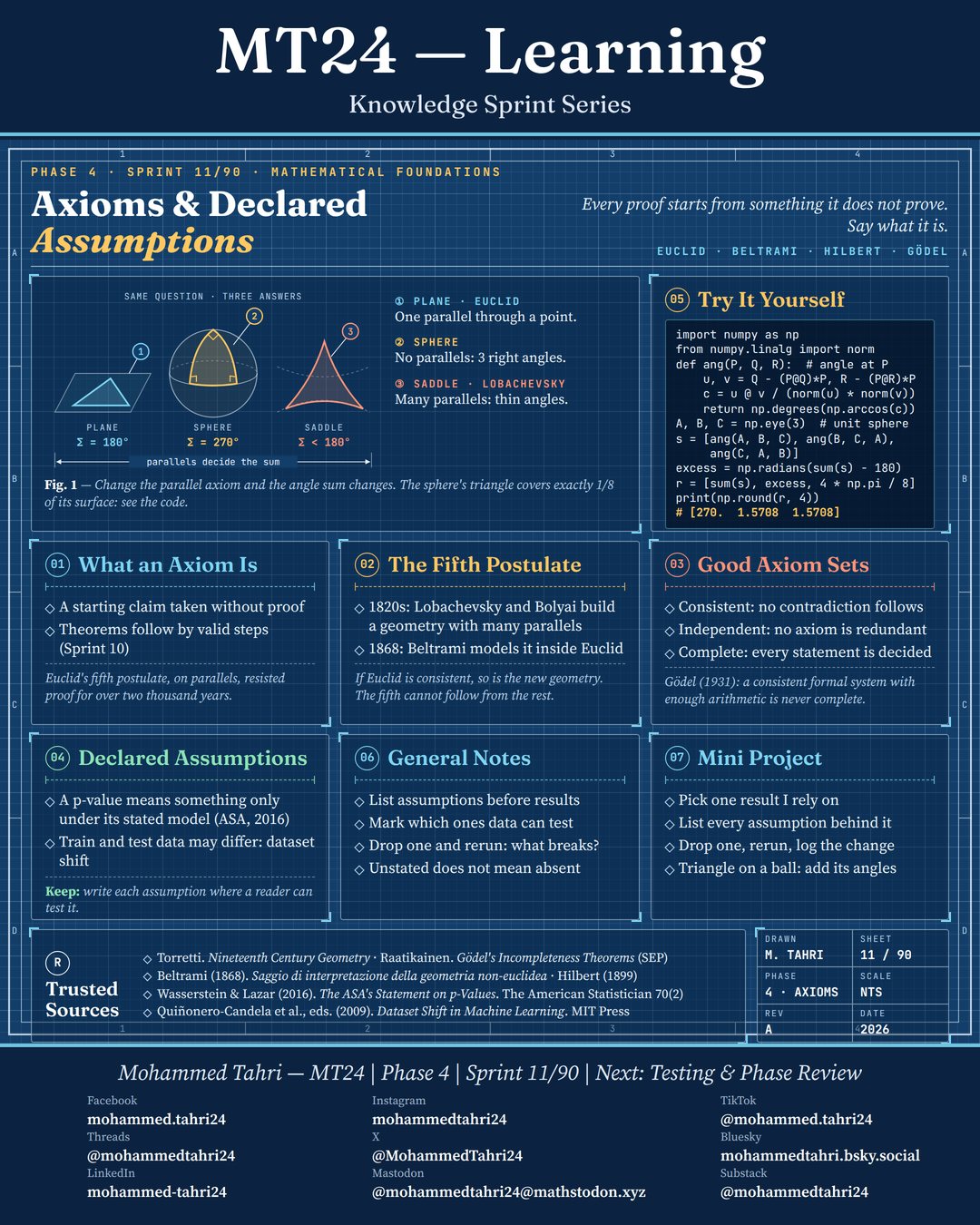
Fig. 1 in words
Change the parallel axiom and the angle sum changes. The sphere's triangle covers exactly 1/8 of its surface: see the code.
Same question · three answers
- plane · Σ = 180°
- sphere · Σ = 270° (right-angle marks at the corners)
- saddle · Σ < 180°
- parallels decide the sum
01 What an Axiom Is
- A starting claim taken without proof
- Theorems follow by valid steps (Sprint 10)
Euclid's fifth postulate, on parallels, resisted proof for over two thousand years.
02 The Fifth Postulate
- 1820s: Lobachevsky and Bolyai build a geometry with many parallels
- 1868: Beltrami models it inside Euclid
If Euclid is consistent, so is the new geometry. The fifth cannot follow from the rest.
03 Good Axiom Sets
- Consistent: no contradiction follows
- Independent: no axiom is redundant
- Complete: every statement is decided
Gödel (1931): a consistent formal system with enough arithmetic is never complete.
04 Declared Assumptions
- A p-value means something only under its stated model (ASA, 2016)
- Train and test data may differ: dataset shift
Keep: write each assumption where a reader can test it.
05 Try It Yourself
sprint11_axioms_declared_assumptions.py
import numpy as np
from numpy.linalg import norm
def ang(P, Q, R):  # angle at P
    u, v = Q - (P@Q)*P, R - (P@R)*P
    c = u @ v / (norm(u) * norm(v))
    return np.degrees(np.arccos(c))
A, B, C = np.eye(3)  # unit sphere
s = [ang(A, B, C), ang(B, C, A),
     ang(C, A, B)]
excess = np.radians(sum(s) - 180)
r = [sum(s), excess, 4 * np.pi / 8]
print(np.round(r, 4))
Output, as printed on the image
[270. 1.5708 1.5708]Run it. sprint11_axioms_declared_assumptions.py · versions, data and steps
06 General Notes
- List assumptions before results
- Mark which ones data can test
- Drop one and rerun: what breaks?
- Unstated does not mean absent
07 Mini Project
- Pick one result I rely on
- List every assumption behind it
- Drop one, rerun, log the change
- Triangle on a ball: add its angles
R Trusted Sources
- Torretti. Nineteenth Century Geometry
- Raatikainen. Gödel's Incompleteness Theorems (SEP)
- Beltrami (1868). Saggio di interpretazione della geometria non-euclidea
- Hilbert (1899)
- Wasserstein & Lazar (2016). The ASA's Statement on p-Values. The American Statistician 70(2)
- Quiñonero-Candela et al., eds. (2009). Dataset Shift in Machine Learning. MIT Press