
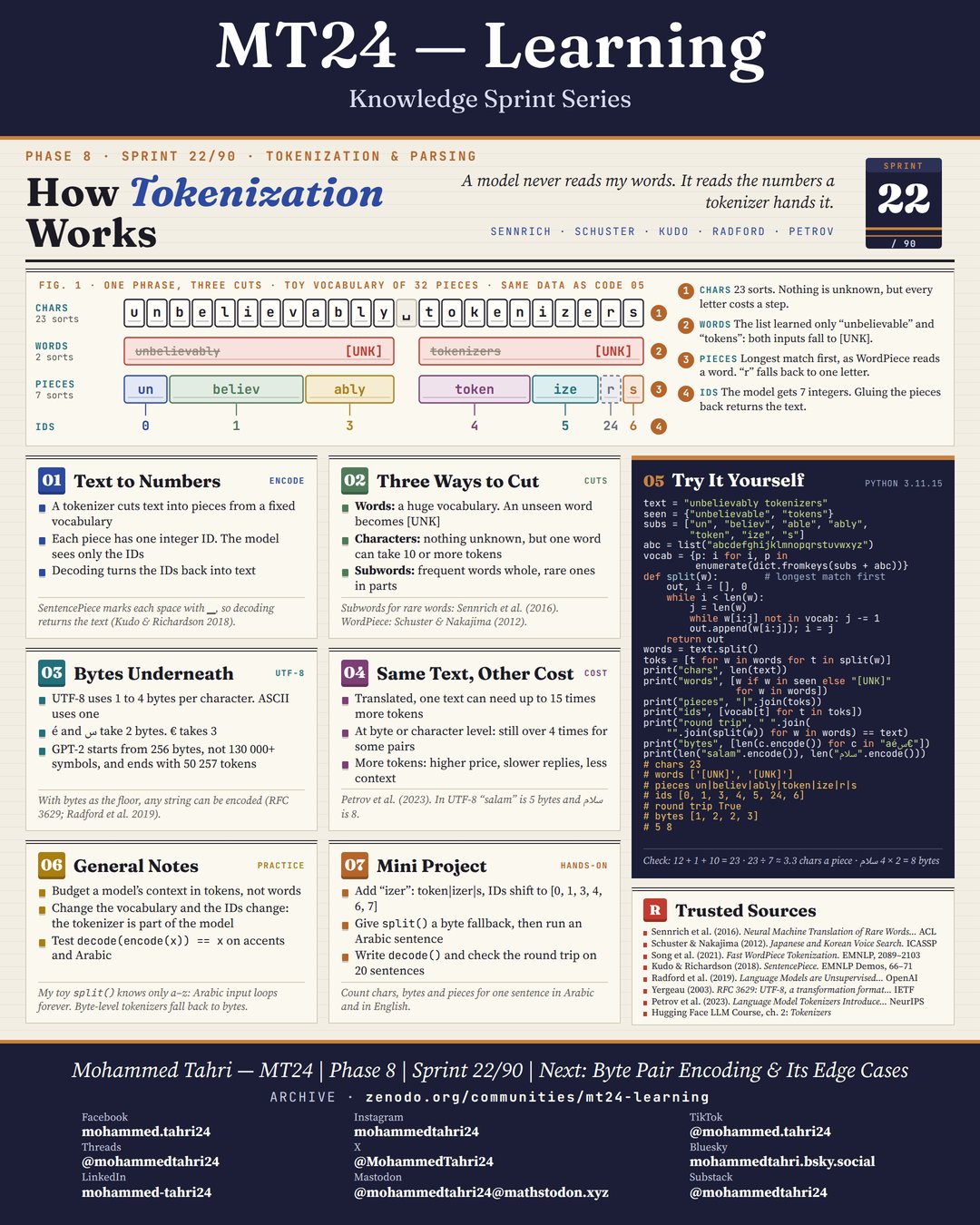
Fig. 1 in words
One phrase, three cuts · toy vocabulary of 32 pieces · same data as code 05
1 Chars
- 23 sorts
- u n b e l i e v a b l y ␣ t o k e n i z e r s
2 Words
- 2 sorts
- unbelievably, struck out: [UNK]
- tokenizers, struck out: [UNK]
3 Pieces
- 7 sorts
- un | believ | ably | token | ize | r | s
- r in a dashed box
4 IDs
- un 0 · believ 1 · ably 3 · token 4 · ize 5 · r 24 · s 6
01 Text to Numbers Encode
- A tokenizer cuts text into pieces from a fixed vocabulary
- Each piece has one integer ID. The model sees only the IDs
- Decoding turns the IDs back into text
SentencePiece marks each space with ▁, so decoding returns the text (Kudo & Richardson 2018).
02 Three Ways to Cut Cuts
- Words: a huge vocabulary. An unseen word becomes [UNK]
- Characters: nothing unknown, but one word can take 10 or more tokens
- Subwords: frequent words whole, rare ones in parts
Subwords for rare words: Sennrich et al. (2016). WordPiece: Schuster & Nakajima (2012).
03 Bytes Underneath UTF-8
- UTF-8 uses 1 to 4 bytes per character. ASCII uses one
- é and س take 2 bytes. € takes 3
- GPT-2 starts from 256 bytes, not 130 000+ symbols, and ends with 50 257 tokens
With bytes as the floor, any string can be encoded (RFC 3629; Radford et al. 2019).
04 Same Text, Other Cost Cost
- Translated, one text can need up to 15 times more tokens
- At byte or character level: still over 4 times for some pairs
- More tokens: higher price, slower replies, less context
Petrov et al. (2023). In UTF-8 “salam” is 5 bytes and سلام is 8.
05 Try It Yourself PYTHON 3.11.15
sprint22_how_tokenization_works.py
text = "unbelievably tokenizers"
seen = {"unbelievable", "tokens"}
subs = ["un", "believ", "able", "ably",
        "token", "ize", "s"]
abc = list("abcdefghijklmnopqrstuvwxyz")
vocab = {p: i for i, p in
         enumerate(dict.fromkeys(subs + abc))}
def split(w):        # longest match first
    out, i = [], 0
    while i < len(w):
        j = len(w)
        while w[i:j] not in vocab: j -= 1
        out.append(w[i:j]); i = j
    return out
words = text.split()
toks = [t for w in words for t in split(w)]
print("chars", len(text))
print("words", [w if w in seen else "[UNK]"
                for w in words])
print("pieces", "|".join(toks))
print("ids", [vocab[t] for t in toks])
print("round trip", " ".join(
    "".join(split(w)) for w in words) == text)
print("bytes", [len(c.encode()) for c in "aéس€"])
print(len("salam".encode()), len("سلام".encode()))
Output, as printed on the image
chars 23
words ['[UNK]', '[UNK]']
pieces un|believ|ably|token|ize|r|s
ids [0, 1, 3, 4, 5, 24, 6]
round trip True
bytes [1, 2, 2, 3]
5 8
Run it. sprint22_how_tokenization_works.py · versions, data and steps
Check: 12 + 1 + 10 = 23 · 23 ÷ 7 ≈ 3.3 chars a piece · سلام 4 × 2 = 8 bytes
06 General Notes Practice
- Budget a model’s context in tokens, not words
- Change the vocabulary and the IDs change: the tokenizer is part of the model
- Test decode(encode(x)) == x on accents and Arabic
My toy split() knows only a–z: Arabic input loops forever. Byte-level tokenizers fall back to bytes.
07 Mini Project Hands-on
- Add “izer”: token|izer|s, IDs shift to [0, 1, 3, 4, 6, 7]
- Give split() a byte fallback, then run an Arabic sentence
- Write decode() and check the round trip on 20 sentences
Count chars, bytes and pieces for one sentence in Arabic and in English.
R Trusted Sources
- Sennrich et al. (2016). Neural Machine Translation of Rare Words… ACL
- Schuster & Nakajima (2012). Japanese and Korean Voice Search. ICASSP
- Song et al. (2021). Fast WordPiece Tokenization. EMNLP, 2089–2103
- Kudo & Richardson (2018). SentencePiece. EMNLP Demos, 66–71
- Radford et al. (2019). Language Models are Unsupervised… OpenAI
- Yergeau (2003). RFC 3629: UTF-8, a transformation format… IETF
- Petrov et al. (2023). Language Model Tokenizers Introduce… NeurIPS
- Hugging Face LLM Course, ch. 2: Tokenizers