
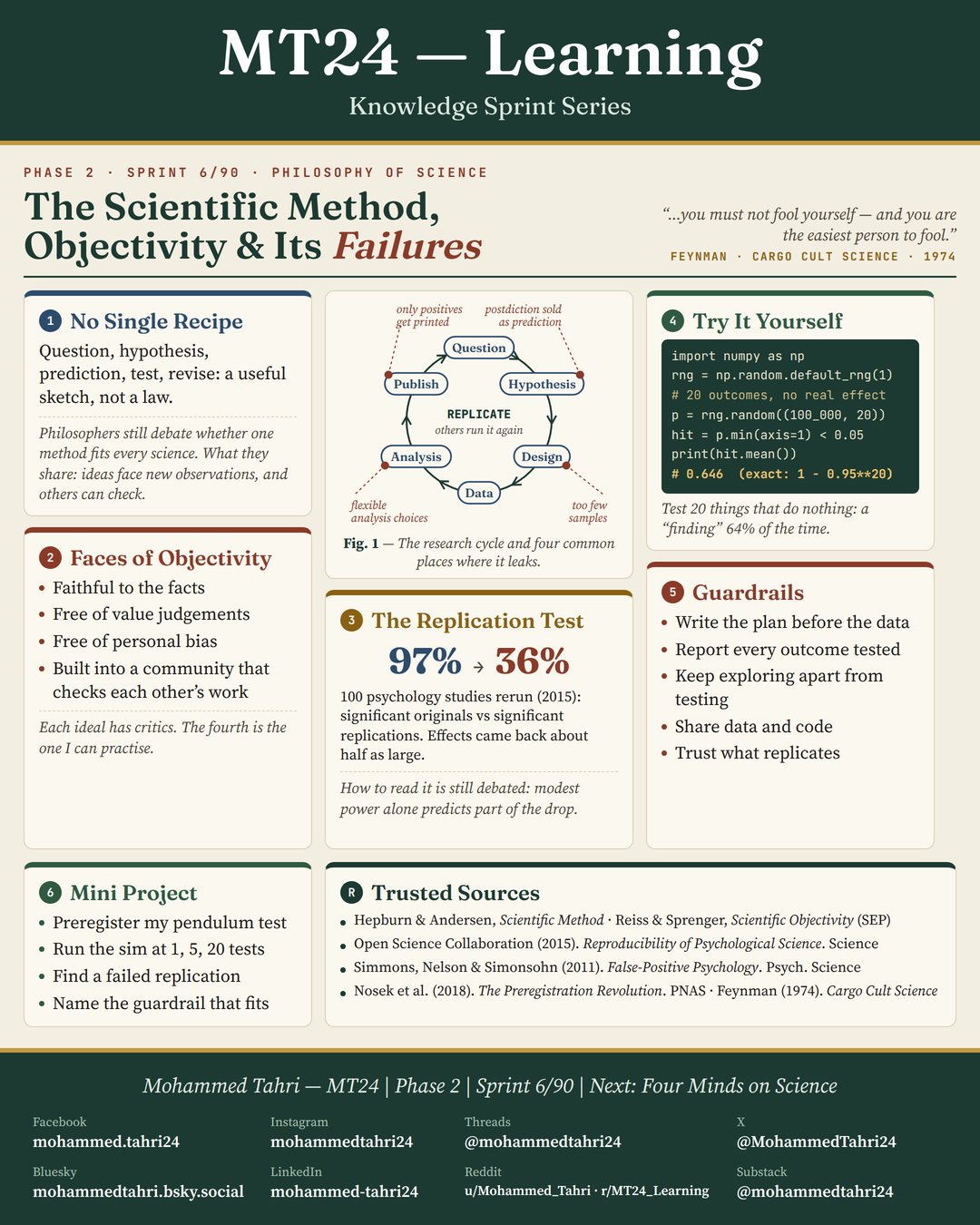
Fig. 1 in words
The research cycle and four common places where it leaks.
- a loop: Question → Hypothesis → Design → Data → Analysis → Publish → Question
- centre: REPLICATE · others run it again
- at Hypothesis: postdiction sold as prediction
- at Design: too few samples
- at Analysis: flexible analysis choices
- at Publish: only positives get printed
1 No Single Recipe
Question, hypothesis, prediction, test, revise: a useful sketch, not a law.
Philosophers still debate whether one method fits every science. What they share: ideas face new observations, and others can check.
2 Faces of Objectivity
- Faithful to the facts
- Free of value judgements
- Free of personal bias
- Built into a community that checks each other’s work
Each ideal has critics. The fourth is the one I can practise.
3 The Replication Test
97% → 36%
100 psychology studies rerun (2015): significant originals vs significant replications. Effects came back about half as large.
How to read it is still debated: modest power alone predicts part of the drop.
4 Try It Yourself
sprint06_scientific_method_objectivity_failures.py
import numpy as np
rng = np.random.default_rng(1)
# 20 outcomes, no real effect
p = rng.random((100_000, 20))
hit = p.min(axis=1) < 0.05
print(hit.mean())
Output, as printed on the image
0.646 (exact: 1 - 0.95**20)Run it. sprint06_scientific_method_objectivity_failures.py · versions, data and steps
- Test 20 things that do nothing: a “finding” 64% of the time.
5 Guardrails
- Write the plan before the data
- Report every outcome tested
- Keep exploring apart from testing
- Share data and code
- Trust what replicates
6 Mini Project
- Preregister my pendulum test
- Run the sim at 1, 5, 20 tests
- Find a failed replication
- Name the guardrail that fits
R Trusted Sources
- Hepburn & Andersen, Scientific Method
- Reiss & Sprenger, Scientific Objectivity (SEP)
- Open Science Collaboration (2015). Reproducibility of Psychological Science. Science
- Simmons, Nelson & Simonsohn (2011). False-Positive Psychology. Psych. Science
- Nosek et al. (2018). The Preregistration Revolution. PNAS
- Feynman (1974). Cargo Cult Science