
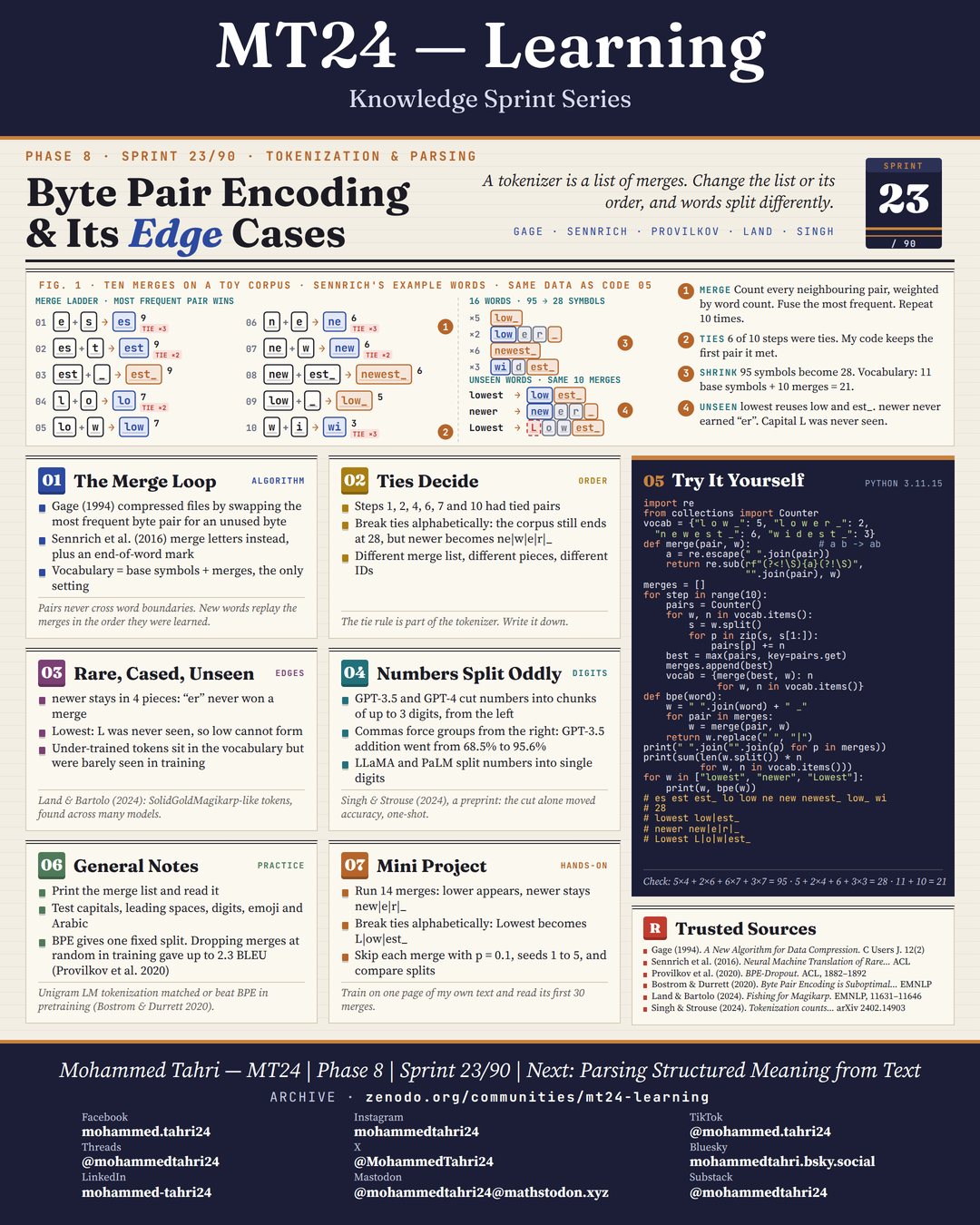
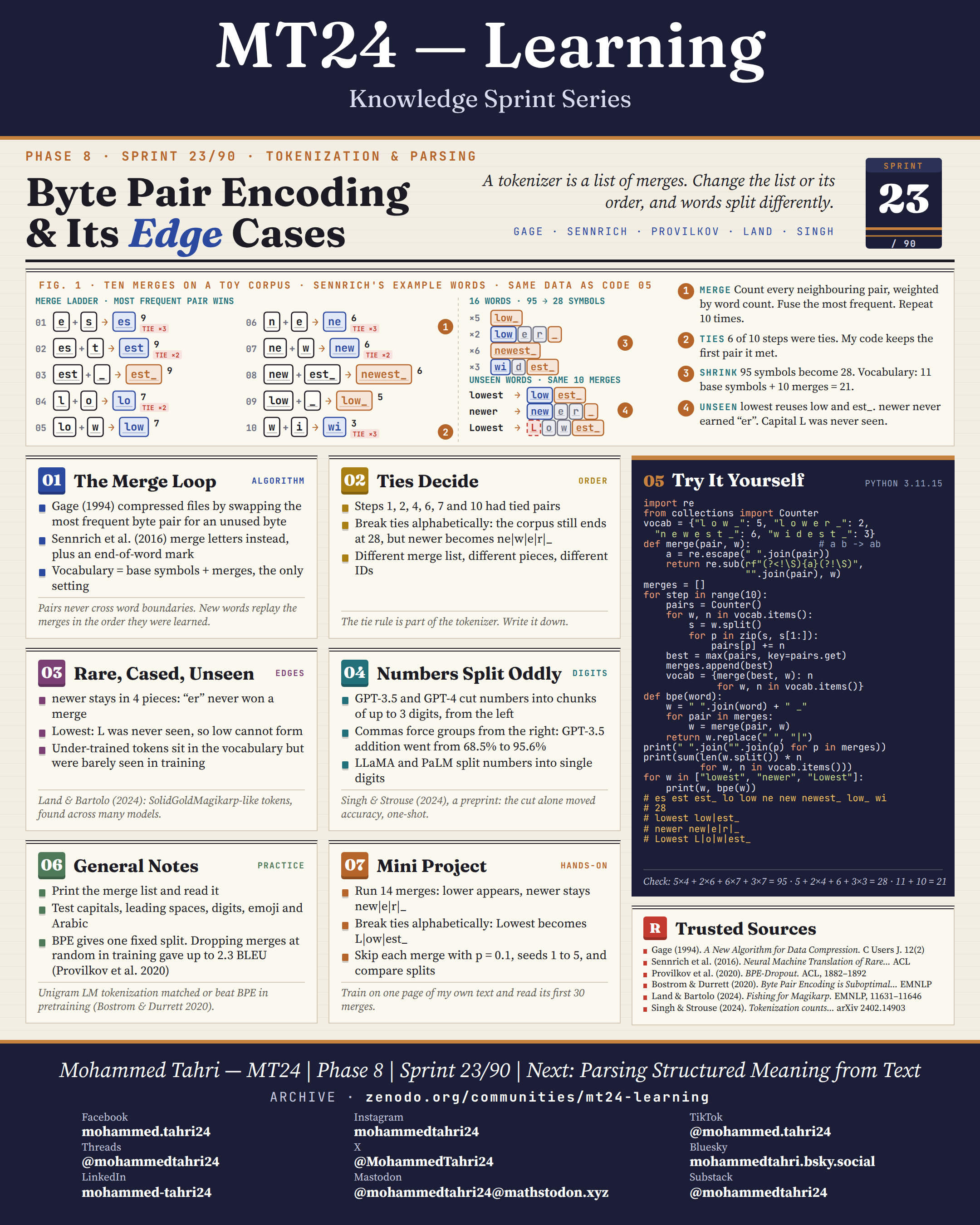
Fig. 1 in words
Ten merges on a toy corpus · Sennrich's example words · same data as code 05
1 Merge ladder · most frequent pair wins
- 01 e + s → es · 9 · tie ×3
- 02 es + t → est · 9 · tie ×2
- 03 est + _ → est_ · 9
- 04 l + o → lo · 7 · tie ×2
- 05 lo + w → low · 7
- 06 n + e → ne · 6 · tie ×3
- 07 ne + w → new · 6 · tie ×2
- 08 new + est_ → newest_ · 6
- 09 low + _ → low_ · 5
- 10 w + i → wi · 3 · tie ×3
2 16 words · 95 → 28 symbols
- ×5 low_
- ×2 low | e | r | _
- ×6 newest_
- ×3 wi | d | est_
3 Unseen words · same 10 merges
- lowest → low | est_
- newer → new | e | r | _
- Lowest → L | o | w | est_
- L in a dashed red box
01 The Merge Loop Algorithm
- Gage (1994) compressed files by swapping the most frequent byte pair for an unused byte
- Sennrich et al. (2016) merge letters instead, plus an end-of-word mark
- Vocabulary = base symbols + merges, the only setting
Pairs never cross word boundaries. New words replay the merges in the order they were learned.
02 Ties Decide Order
- Steps 1, 2, 4, 6, 7 and 10 had tied pairs
- Break ties alphabetically: the corpus still ends at 28, but newer becomes ne|w|e|r|_
- Different merge list, different pieces, different IDs
The tie rule is part of the tokenizer. Write it down.
03 Rare, Cased, Unseen Edges
- newer stays in 4 pieces: “er” never won a merge
- Lowest: L was never seen, so low cannot form
- Under-trained tokens sit in the vocabulary but were barely seen in training
Land & Bartolo (2024): SolidGoldMagikarp-like tokens, found across many models.
04 Numbers Split Oddly Digits
- GPT-3.5 and GPT-4 cut numbers into chunks of up to 3 digits, from the left
- Commas force groups from the right: GPT-3.5 addition went from 68.5% to 95.6%
- LLaMA and PaLM split numbers into single digits
Singh & Strouse (2024), a preprint: the cut alone moved accuracy, one-shot.
05 Try It Yourself PYTHON 3.11.15
sprint23_byte_pair_encoding_edge_cases.py
import re
from collections import Counter
vocab = {"l o w _": 5, "l o w e r _": 2,
  "n e w e s t _": 6, "w i d e s t _": 3}
def merge(pair, w):            # a b -> ab
    a = re.escape(" ".join(pair))
    return re.sub(rf"(?<!\S){a}(?!\S)",
                  "".join(pair), w)
merges = []
for step in range(10):
    pairs = Counter()
    for w, n in vocab.items():
        s = w.split()
        for p in zip(s, s[1:]):
            pairs[p] += n
    best = max(pairs, key=pairs.get)
    merges.append(best)
    vocab = {merge(best, w): n
             for w, n in vocab.items()}
def bpe(word):
    w = " ".join(word) + " _"
    for pair in merges:
        w = merge(pair, w)
    return w.replace(" ", "|")
print(" ".join("".join(p) for p in merges))
print(sum(len(w.split()) * n
          for w, n in vocab.items()))
for w in ["lowest", "newer", "Lowest"]:
    print(w, bpe(w))
Output, as printed on the image
es est est_ lo low ne new newest_ low_ wi
28
lowest low|est_
newer new|e|r|_
Lowest L|o|w|est_
Run it. sprint23_byte_pair_encoding_edge_cases.py · versions, data and steps
Check: 5×4 + 2×6 + 6×7 + 3×7 = 95 · 5 + 2×4 + 6 + 3×3 = 28 · 11 + 10 = 21
06 General Notes Practice
- Print the merge list and read it
- Test capitals, leading spaces, digits, emoji and Arabic
- BPE gives one fixed split. Dropping merges at random in training gave up to 2.3 BLEU (Provilkov et al. 2020)
Unigram LM tokenization matched or beat BPE in pretraining (Bostrom & Durrett 2020).
07 Mini Project Hands-on
- Run 14 merges: lower appears, newer stays new|e|r|_
- Break ties alphabetically: Lowest becomes L|ow|est_
- Skip each merge with p = 0.1, seeds 1 to 5, and compare splits
Train on one page of my own text and read its first 30 merges.
R Trusted Sources
- Gage (1994). A New Algorithm for Data Compression. C Users J. 12(2)
- Sennrich et al. (2016). Neural Machine Translation of Rare… ACL
- Provilkov et al. (2020). BPE-Dropout. ACL, 1882–1892
- Bostrom & Durrett (2020). Byte Pair Encoding is Suboptimal… EMNLP
- Land & Bartolo (2024). Fishing for Magikarp. EMNLP, 11631–11646
- Singh & Strouse (2024). Tokenization counts… arXiv 2402.14903