
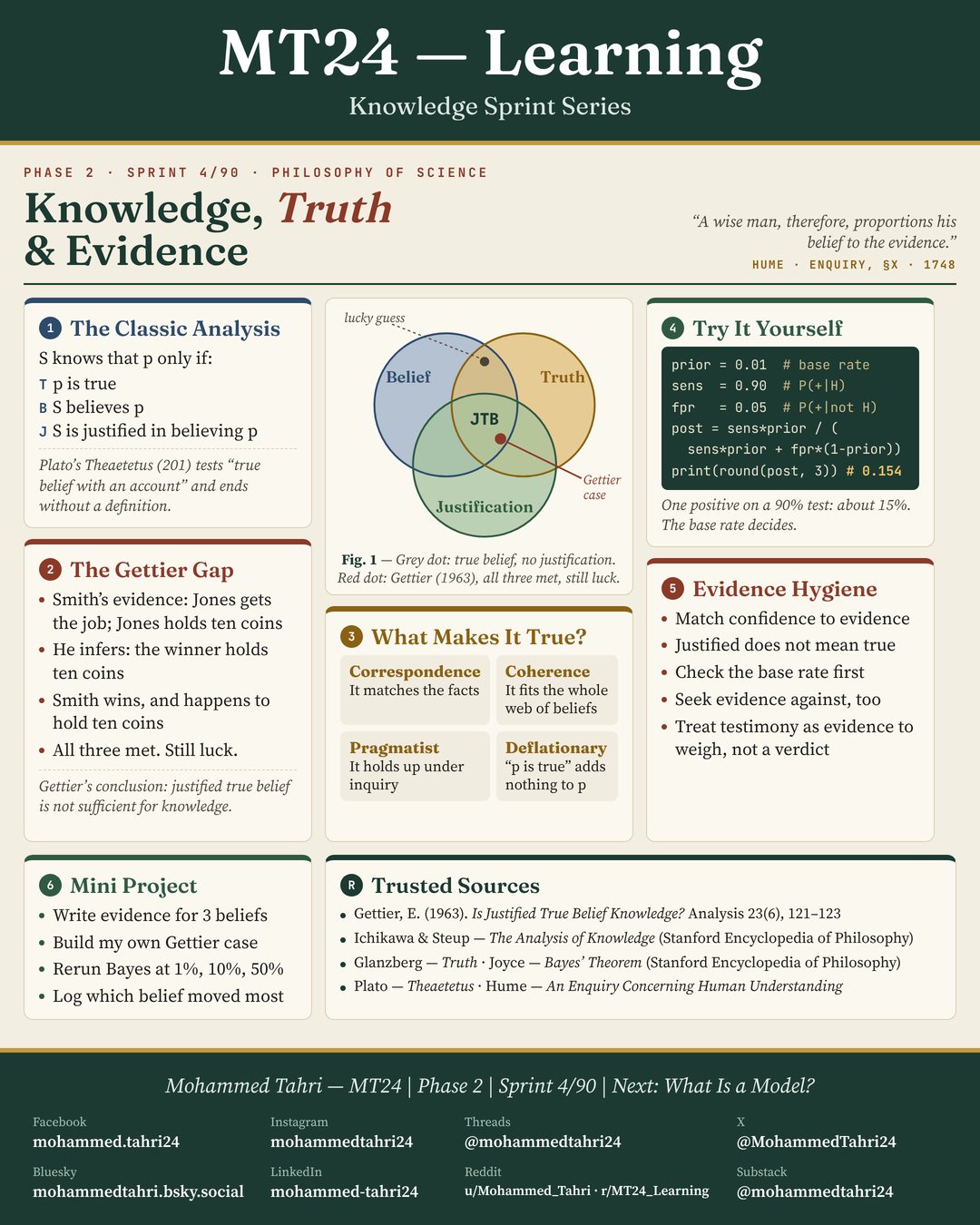
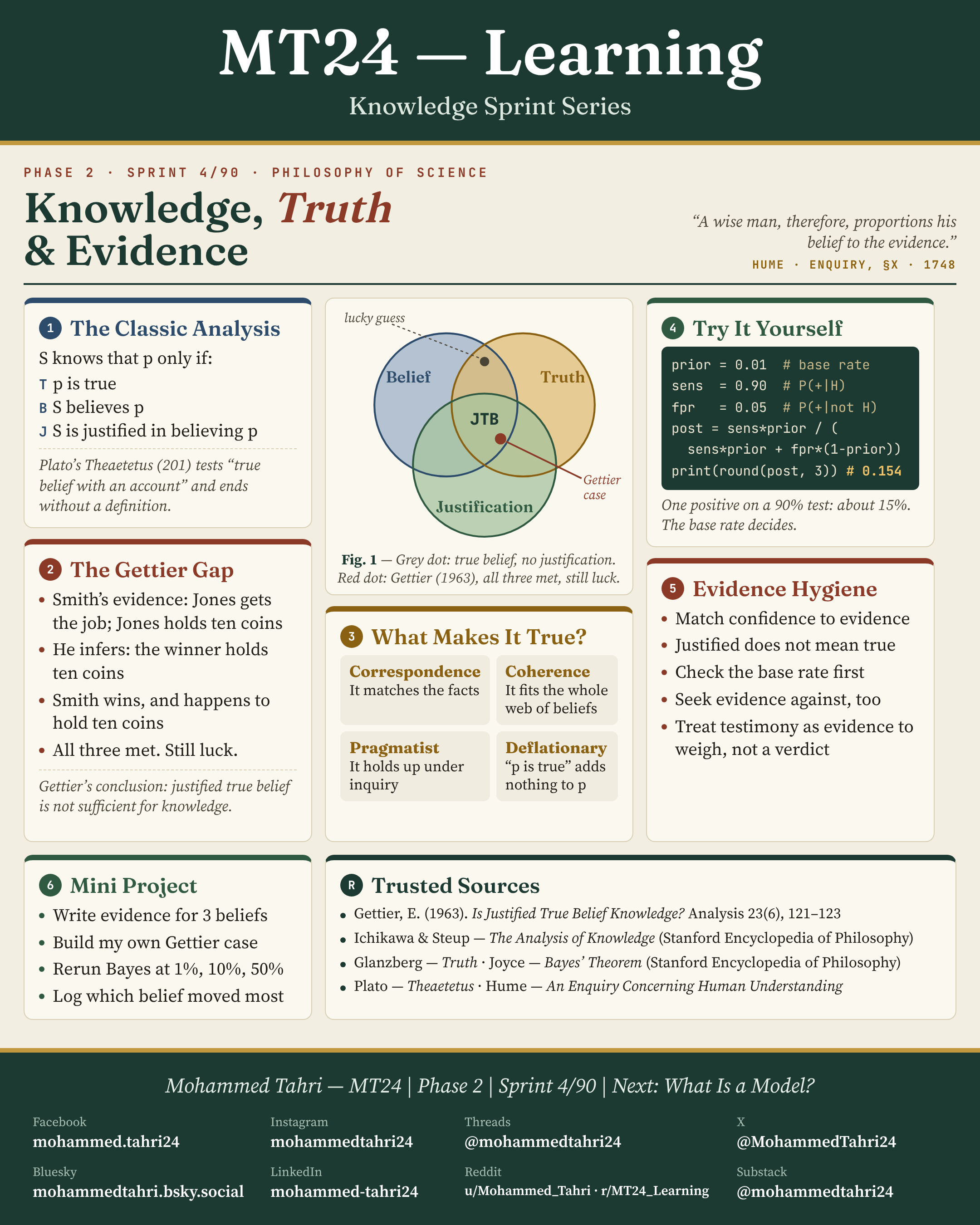
Fig. 1 in words
Grey dot: true belief, no justification. Red dot: Gettier (1963), all three met, still luck.
- three overlapping circles: Belief · Truth · Justification
- JTB where all three meet
- lucky guess: a grey dot inside Belief and Truth, outside Justification
- Gettier case: a red dot inside all three
1 The Classic Analysis
S knows that p only if:
- T p is true
- B S believes p
- J S is justified in believing p
Plato’s Theaetetus (201) tests “true belief with an account” and ends without a definition.
2 The Gettier Gap
- Smith’s evidence: Jones gets the job; Jones holds ten coins
- He infers: the winner holds ten coins
- Smith wins, and happens to hold ten coins
- All three met. Still luck.
Gettier’s conclusion: justified true belief is not sufficient for knowledge.
3 What Makes It True?
- Correspondence It matches the facts
- Coherence It fits the whole web of beliefs
- Pragmatist It holds up under inquiry
- Deflationary “p is true” adds nothing to p
4 Try It Yourself
sprint04_knowledge_truth_evidence.py
prior = 0.01  # base rate
sens  = 0.90  # P(+|H)
fpr   = 0.05  # P(+|not H)
post = sens*prior / (
  sens*prior + fpr*(1-prior))
print(round(post, 3)) # 0.154
Run it. sprint04_knowledge_truth_evidence.py · versions, data and steps
- One positive on a 90% test: about 15%. The base rate decides.
5 Evidence Hygiene
- Match confidence to evidence
- Justified does not mean true
- Check the base rate first
- Seek evidence against, too
- Treat testimony as evidence to weigh, not a verdict
6 Mini Project
- Write evidence for 3 beliefs
- Build my own Gettier case
- Rerun Bayes at 1%, 10%, 50%
- Log which belief moved most
R Trusted Sources
- Gettier, E. (1963). Is Justified True Belief Knowledge? Analysis 23(6), 121–123
- Ichikawa & Steup — The Analysis of Knowledge (Stanford Encyclopedia of Philosophy)
- Glanzberg — Truth
- Joyce — Bayes’ Theorem (Stanford Encyclopedia of Philosophy)
- Plato — Theaetetus
- Hume — An Enquiry Concerning Human Understanding