
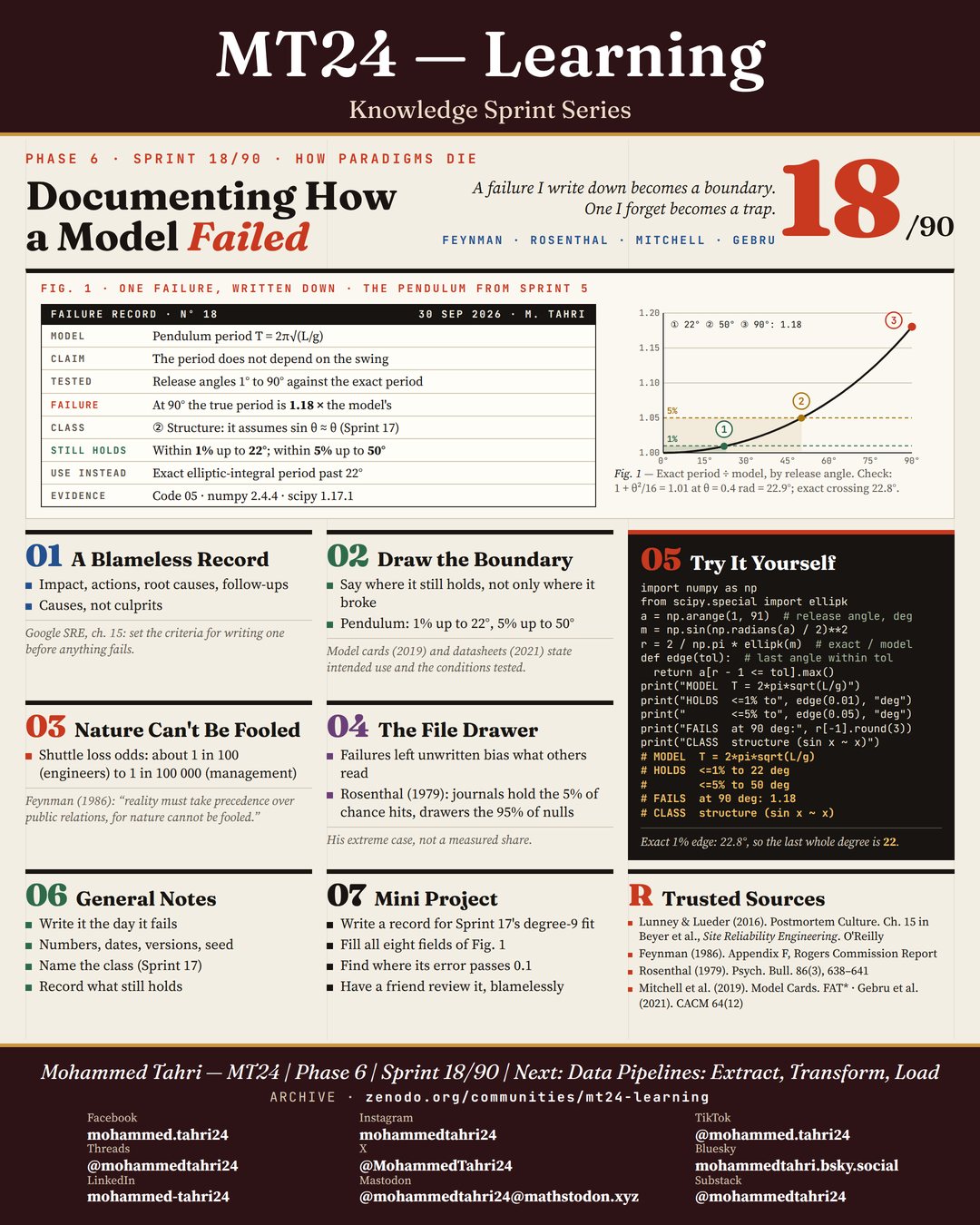
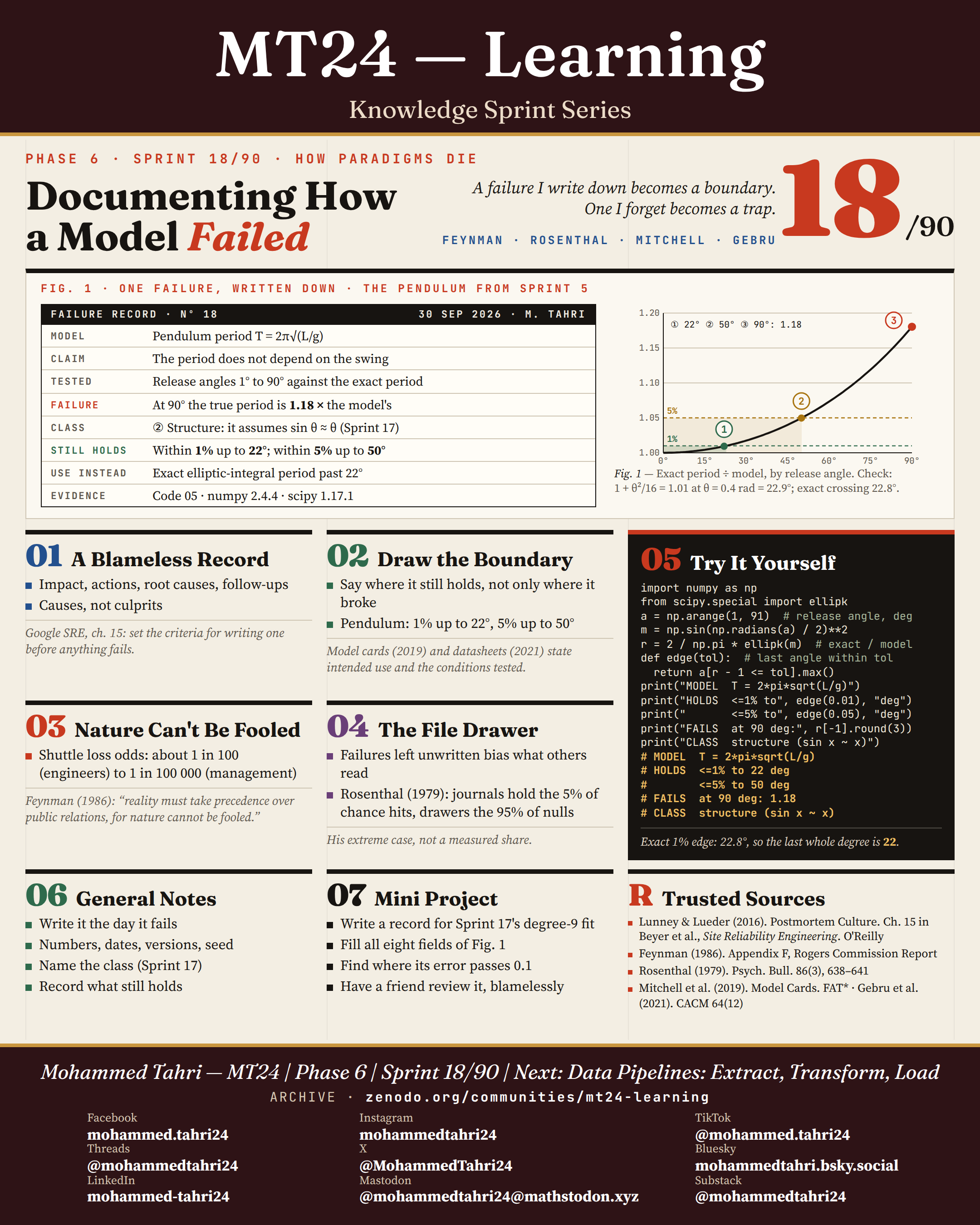
Fig. 1 in words
One failure, written down · the pendulum from Sprint 5
1 Failure record · N° 18 · 30 Sep 2026 · M. Tahri
- Model · Pendulum period T = 2π√(L/g)
- Claim · The period does not depend on the swing
- Tested · Release angles 1° to 90° against the exact period
- Failure · At 90° the true period is 1.18 × the model's
- Class · ② Structure: it assumes sin θ ≈ θ (Sprint 17)
- Still holds · Within 1% up to 22°; within 5% up to 50°
- Use instead · Exact elliptic-integral period past 22°
- Evidence · Code 05 · numpy 2.4.4 · scipy 1.17.1
2 Exact period ÷ model, by release angle
- the curve rises from 1.00 at 0° to 1.18 at 90° · axes 1.00 to 1.20 and 0° to 90°
- dashed lines at 1% and 5%
- ① 22° ② 50° ③ 90°: 1.18
- Fig. 1 — Exact period ÷ model, by release angle. Check: 1 + θ²/16 = 1.01 at θ = 0.4 rad = 22.9°; exact crossing 22.8°.
01 A Blameless Record
- Impact, actions, root causes, follow-ups
- Causes, not culprits
Google SRE, ch. 15: set the criteria for writing one before anything fails.
02 Draw the Boundary
- Say where it still holds, not only where it broke
- Pendulum: 1% up to 22°, 5% up to 50°
Model cards (2019) and datasheets (2021) state intended use and the conditions tested.
03 Nature Can't Be Fooled
- Shuttle loss odds: about 1 in 100 (engineers) to 1 in 100 000 (management)
Feynman (1986): “reality must take precedence over public relations, for nature cannot be fooled.”
04 The File Drawer
- Failures left unwritten bias what others read
- Rosenthal (1979): journals hold the 5% of chance hits, drawers the 95% of nulls
His extreme case, not a measured share.
05 Try It Yourself
sprint18_documenting_how_a_model_failed.py
import numpy as np
from scipy.special import ellipk
a = np.arange(1, 91)  # release angle, deg
m = np.sin(np.radians(a) / 2)**2
r = 2 / np.pi * ellipk(m)  # exact / model
def edge(tol):  # last angle within tol
  return a[r - 1 <= tol].max()
print("MODEL  T = 2*pi*sqrt(L/g)")
print("HOLDS  <=1% to", edge(0.01), "deg")
print("       <=5% to", edge(0.05), "deg")
print("FAILS  at 90 deg:", r[-1].round(3))
print("CLASS  structure (sin x ~ x)")
Output, as printed on the image
MODEL  T = 2*pi*sqrt(L/g)
HOLDS  <=1% to 22 deg
       <=5% to 50 deg
FAILS  at 90 deg: 1.18
CLASS  structure (sin x ~ x)
Run it. sprint18_documenting_how_a_model_failed.py · versions, data and steps
Exact 1% edge: 22.8°, so the last whole degree is 22.
06 General Notes
- Write it the day it fails
- Numbers, dates, versions, seed
- Name the class (Sprint 17)
- Record what still holds
07 Mini Project
- Write a record for Sprint 17's degree-9 fit
- Fill all eight fields of Fig. 1
- Find where its error passes 0.1
- Have a friend review it, blamelessly