
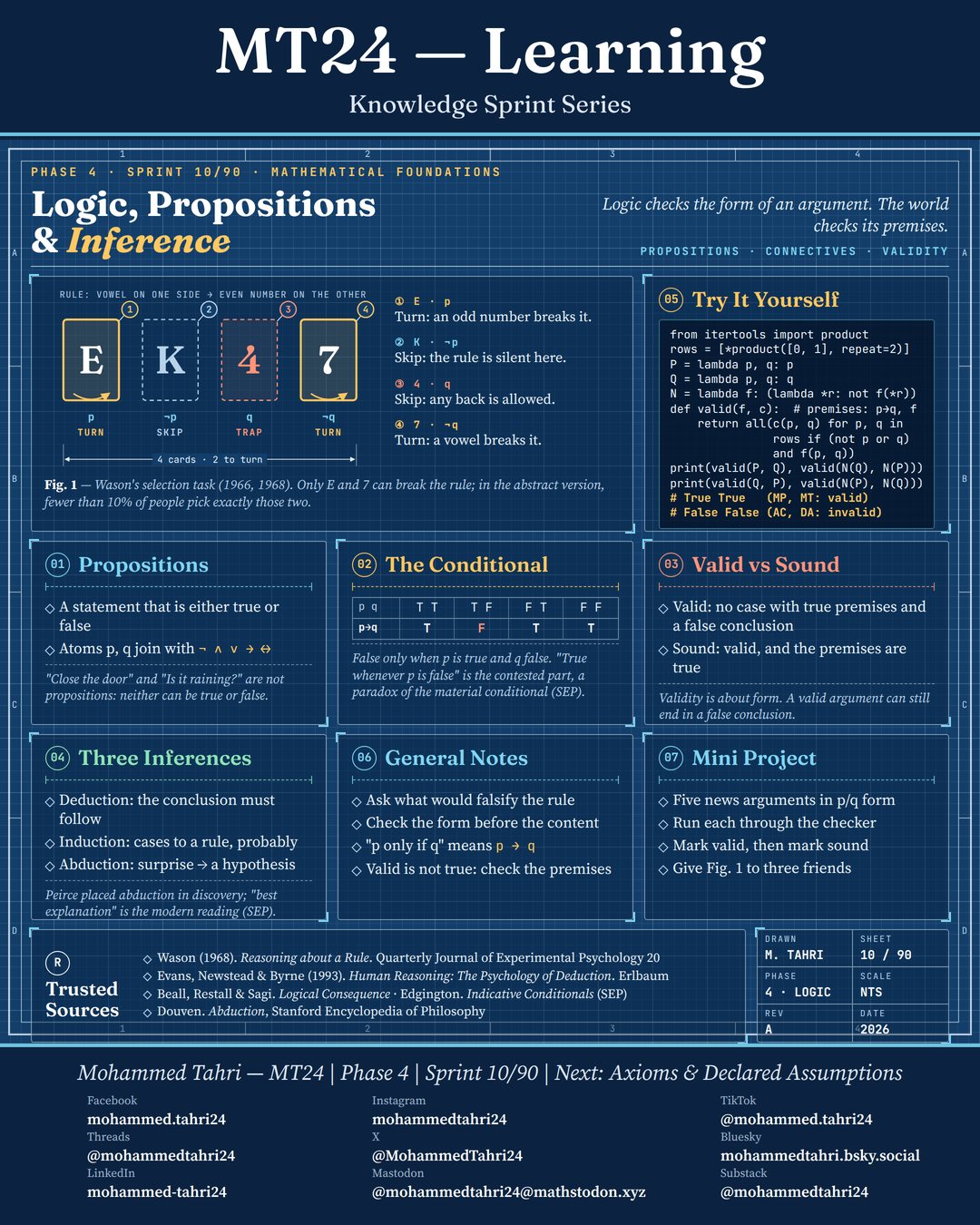
Fig. 1 in words
Wason's selection task (1966, 1968). Only E and 7 can break the rule; in the abstract version, fewer than 10% of people pick exactly those two.
Rule: vowel on one side → even number on the other
- E · p · turn
- K · ¬p · skip
- 4 · q · trap
- 7 · ¬q · turn
- 4 cards · 2 to turn
01 Propositions
- A statement that is either true or false
- Atoms p, q join with ¬ ∧ ∨ → ↔
"Close the door" and "Is it raining?" are not propositions: neither can be true or false.
02 The Conditional
- p q: T T · T F · F T · F F
- p→q: T · F · T · T
False only when p is true and q false. "True whenever p is false" is the contested part, a paradox of the material conditional (SEP).
03 Valid vs Sound
- Valid: no case with true premises and a false conclusion
- Sound: valid, and the premises are true
Validity is about form. A valid argument can still end in a false conclusion.
04 Three Inferences
- Deduction: the conclusion must follow
- Induction: cases to a rule, probably
- Abduction: surprise → a hypothesis
Peirce placed abduction in discovery; "best explanation" is the modern reading (SEP).
05 Try It Yourself
sprint10_logic_propositions_inference.py
from itertools import product
rows = [*product([0, 1], repeat=2)]
P = lambda p, q: p
Q = lambda p, q: q
N = lambda f: (lambda *r: not f(*r))
def valid(f, c):  # premises: p→q, f
    return all(c(p, q) for p, q in
               rows if (not p or q)
               and f(p, q))
print(valid(P, Q), valid(N(Q), N(P)))
print(valid(Q, P), valid(N(P), N(Q)))
Output, as printed on the image
True True   (MP, MT: valid)
False False (AC, DA: invalid)
Run it. sprint10_logic_propositions_inference.py · versions, data and steps
06 General Notes
- Ask what would falsify the rule
- Check the form before the content
- "p only if q" means p → q
- Valid is not true: check the premises
07 Mini Project
- Five news arguments in p/q form
- Run each through the checker
- Mark valid, then mark sound
- Give Fig. 1 to three friends
R Trusted Sources
- Wason (1968). Reasoning about a Rule. Quarterly Journal of Experimental Psychology 20
- Evans, Newstead & Byrne (1993). Human Reasoning: The Psychology of Deduction. Erlbaum
- Beall, Restall & Sagi. Logical Consequence
- Edgington. Indicative Conditionals (SEP)
- Douven. Abduction, Stanford Encyclopedia of Philosophy