
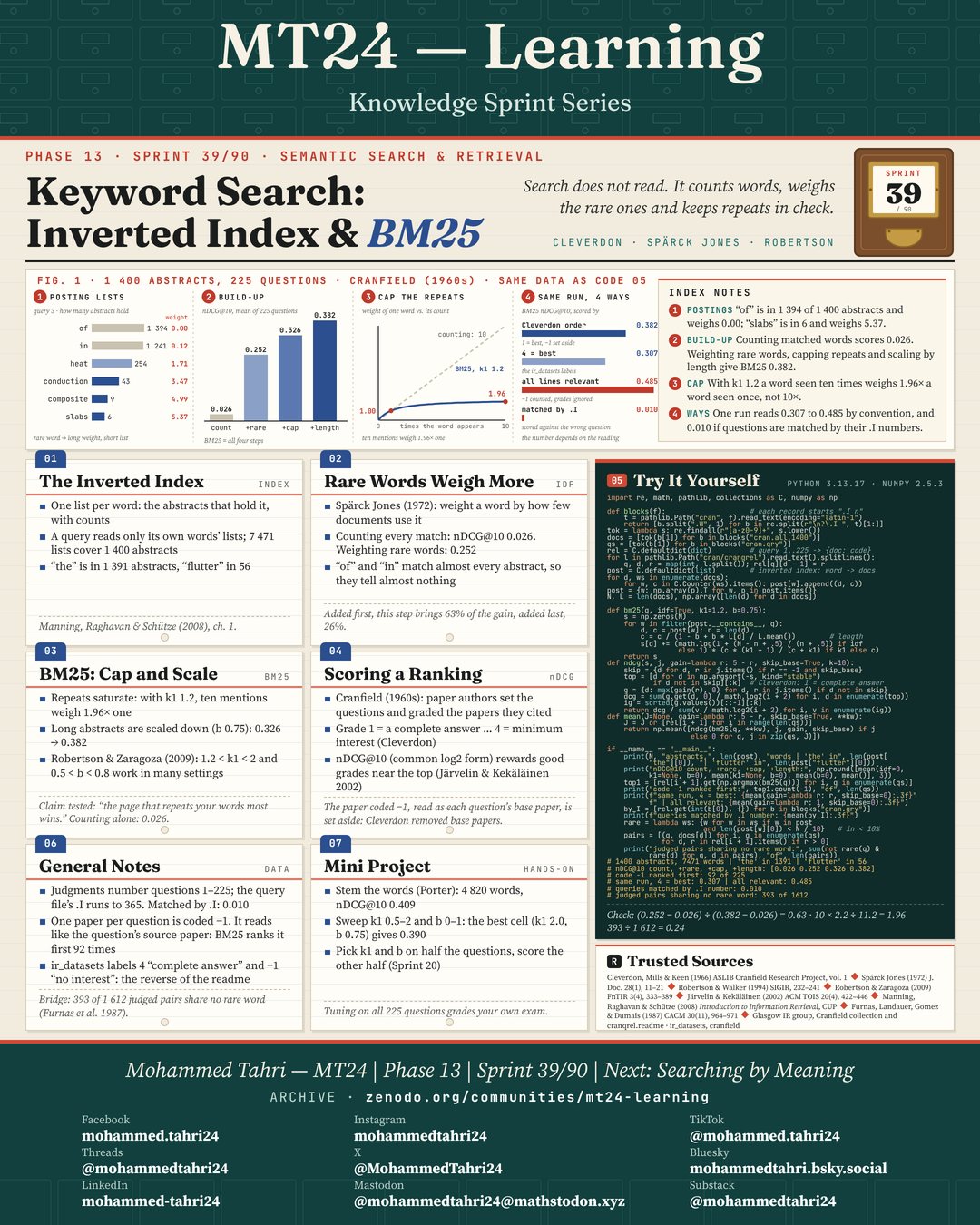

Fig. 1 in words
1 400 abstracts, 225 questions · Cranfield (1960s) · same data as code 05
1 Posting lists
- query 3 · how many abstracts hold
- of: 1 394 · weight 0.00
- in: 1 241 · weight 0.12
- heat: 254 · weight 1.71
- conduction: 43 · weight 3.47
- composite: 9 · weight 4.99
- slabs: 6 · weight 5.37
- rare word → long weight, short list
2 Build-up
- nDCG@10, mean of 225 questions
- count 0.026 · +rare 0.252 · +cap 0.326 · +length 0.382
- BM25 = all four steps
3 Cap the repeats
- weight of one word vs. its count
- counting: 10 · BM25, k1 1.2: 1.00 at one mention, 1.96 at ten
- times the word appears, 0 to 10
- ten mentions weigh 1.96× one
4 Same run, 4 ways
- BM25 nDCG@10, scored by
- Cleverdon order: 0.382 · 1 = best, −1 set aside
- 4 = best: 0.307 · the ir_datasets labels
- all lines relevant: 0.485 · −1 counted, grades ignored
- matched by .I: 0.010 · scored against the wrong question
- the number depends on the reading
01 The Inverted Index Index
- One list per word: the abstracts that hold it, with counts
- A query reads only its own words’ lists; 7 471 lists cover 1 400 abstracts
- “the” is in 1 391 abstracts, “flutter” in 56
Manning, Raghavan & Schütze (2008), ch. 1.
02 Rare Words Weigh More IDF
- Spärck Jones (1972): weight a word by how few documents use it
- Counting every match: nDCG@10 0.026. Weighting rare words: 0.252
- “of” and “in” match almost every abstract, so they tell almost nothing
Added first, this step brings 63% of the gain; added last, 26%.
03 BM25: Cap and Scale BM25
- Repeats saturate: with k1 1.2, ten mentions weigh 1.96× one
- Long abstracts are scaled down (b 0.75): 0.326 → 0.382
- Robertson & Zaragoza (2009): 1.2 < k1 < 2 and 0.5 < b < 0.8 work in many settings
Claim tested: “the page that repeats your words most wins.” Counting alone: 0.026.
04 Scoring a Ranking nDCG
- Cranfield (1960s): paper authors set the questions and graded the papers they cited
- Grade 1 = a complete answer … 4 = minimum interest (Cleverdon)
- nDCG@10 (common log2 form) rewards good grades near the top (Järvelin & Kekäläinen 2002)
The paper coded −1, read as each question’s base paper, is set aside: Cleverdon removed base papers.
05 Try It Yourself PYTHON 3.13.17 · NUMPY 2.5.3
sprint39_keyword_search_inverted_index_bm25.py
import re, math, pathlib, collections as C, numpy as np

def blocks(f):                    # each record starts ".I n"
    t = pathlib.Path("cran", f).read_text(encoding="latin-1")
    return [b.split(".W", 1) for b in re.split(r"\n?\.I ", t)[1:]]
tok = lambda s: re.findall(r"[a-z0-9]+", s.lower())
docs = [tok(b[1]) for b in blocks("cran.all.1400")]
qs = [tok(b[1]) for b in blocks("cran.qry")]
rel = C.defaultdict(dict)         # query 1..225 -> {doc: code}
for l in pathlib.Path("cran/cranqrel").read_text().splitlines():
    q, d, r = map(int, l.split()); rel[q][d - 1] = r
post = C.defaultdict(list)        # inverted index: word -> docs
for d, ws in enumerate(docs):
    for w, c in C.Counter(ws).items(): post[w].append((d, c))
post = {w: np.array(p).T for w, p in post.items()}
N, L = len(docs), np.array([len(d) for d in docs])

def bm25(q, idf=True, k1=1.2, b=0.75):
    s = np.zeros(N)
    for w in filter(post.__contains__, q):
        d, c = post[w]; n = len(d)
        c = c / (1 - b + b * L[d] / L.mean())        # length
        s[d] += (math.log(1 + (N - n + .5) / (n + .5)) if idf
                 else 1) * (c * (k1 + 1) / (c + k1) if k1 else c)
    return s
def ndcg(s, j, gain=lambda r: 5 - r, skip_base=True, k=10):
    skip = {d for d, r in j.items() if r == -1 and skip_base}
    top = [d for d in np.argsort(-s, kind="stable")
           if d not in skip][:k]  # Cleverdon: 1 = complete answer
    g = {d: max(gain(r), 0) for d, r in j.items() if d not in skip}
    dcg = sum(g.get(d, 0) / math.log2(i + 2) for i, d in enumerate(top))
    ig = sorted(g.values())[::-1][:k]
    return dcg / sum(v / math.log2(i + 2) for i, v in enumerate(ig))
def mean(J=None, gain=lambda r: 5 - r, skip_base=True, **kw):
    J = J or [rel[i + 1] for i in range(len(qs))]
    return np.mean([ndcg(bm25(q, **kw), j, gain, skip_base) if j
                    else 0 for q, j in zip(qs, J)])

if __name__ == "__main__":
    print(N, "abstracts,", len(post), "words | 'the' in", len(post[
          "the"][0]), "| 'flutter' in", len(post["flutter"][0]))
    print("nDCG@10 count, +rare, +cap, +length:", np.round([mean(idf=0,
          k1=None, b=0), mean(k1=None, b=0), mean(b=0), mean()], 3))
    top1 = [rel[i + 1].get(np.argmax(bm25(q))) for i, q in enumerate(qs)]
    print("code -1 ranked first:", top1.count(-1), "of", len(qs))
    print(f"same run, 4 = best: {mean(gain=lambda r: r, skip_base=0):.3f}"
          f" | all relevant: {mean(gain=lambda r: 1, skip_base=0):.3f}")
    by_I = [rel.get(int(b[0]), {}) for b in blocks("cran.qry")]
    print(f"queries matched by .I number: {mean(by_I):.3f}")
    rare = lambda ws: {w for w in ws if w in post
                       and len(post[w][0]) < N / 10}   # in < 10%
    pairs = [(q, docs[d]) for i, q in enumerate(qs)
             for d, r in rel[i + 1].items() if r > 0]
    print("judged pairs sharing no rare word:", sum(not rare(q) &
          rare(d) for q, d in pairs), "of", len(pairs))
Output, as printed on the image
1400 abstracts, 7471 words | 'the' in 1391 | 'flutter' in 56
nDCG@10 count, +rare, +cap, +length: [0.026 0.252 0.326 0.382]
code -1 ranked first: 92 of 225
same run, 4 = best: 0.307 | all relevant: 0.485
queries matched by .I number: 0.010
judged pairs sharing no rare word: 393 of 1612
Run it. sprint39_keyword_search_inverted_index_bm25.py · versions, data and steps
Check: (0.252 − 0.026) ÷ (0.382 − 0.026) = 0.63 · 10 × 2.2 ÷ 11.2 = 1.96
393 ÷ 1 612 = 0.24
06 General Notes Data
- Judgments number questions 1–225; the query file’s .I runs to 365. Matched by .I: 0.010
- One paper per question is coded −1. It reads like the question’s source paper: BM25 ranks it first 92 times
- ir_datasets labels 4 “complete answer” and −1 “no interest”: the reverse of the readme
Bridge: 393 of 1 612 judged pairs share no rare word (Furnas et al. 1987).
07 Mini Project Hands-on
- Stem the words (Porter): 4 820 words, nDCG@10 0.409
- Sweep k1 0.5–2 and b 0–1: the best cell (k1 2.0, b 0.75) gives 0.390
- Pick k1 and b on half the questions, score the other half (Sprint 20)
Tuning on all 225 questions grades your own exam.
R Trusted Sources
- Cleverdon, Mills & Keen (1966) ASLIB Cranfield Research Project, vol. 1
- Spärck Jones (1972) J. Doc. 28(1), 11–21
- Robertson & Walker (1994) SIGIR, 232–241
- Robertson & Zaragoza (2009) FnTIR 3(4), 333–389
- Järvelin & Kekäläinen (2002) ACM TOIS 20(4), 422–446
- Manning, Raghavan & Schütze (2008) Introduction to Information Retrieval, CUP
- Furnas, Landauer, Gomez & Dumais (1987) CACM 30(11), 964–971
- Glasgow IR group, Cranfield collection and cranqrel.readme · ir_datasets, cranfield