
Abstract
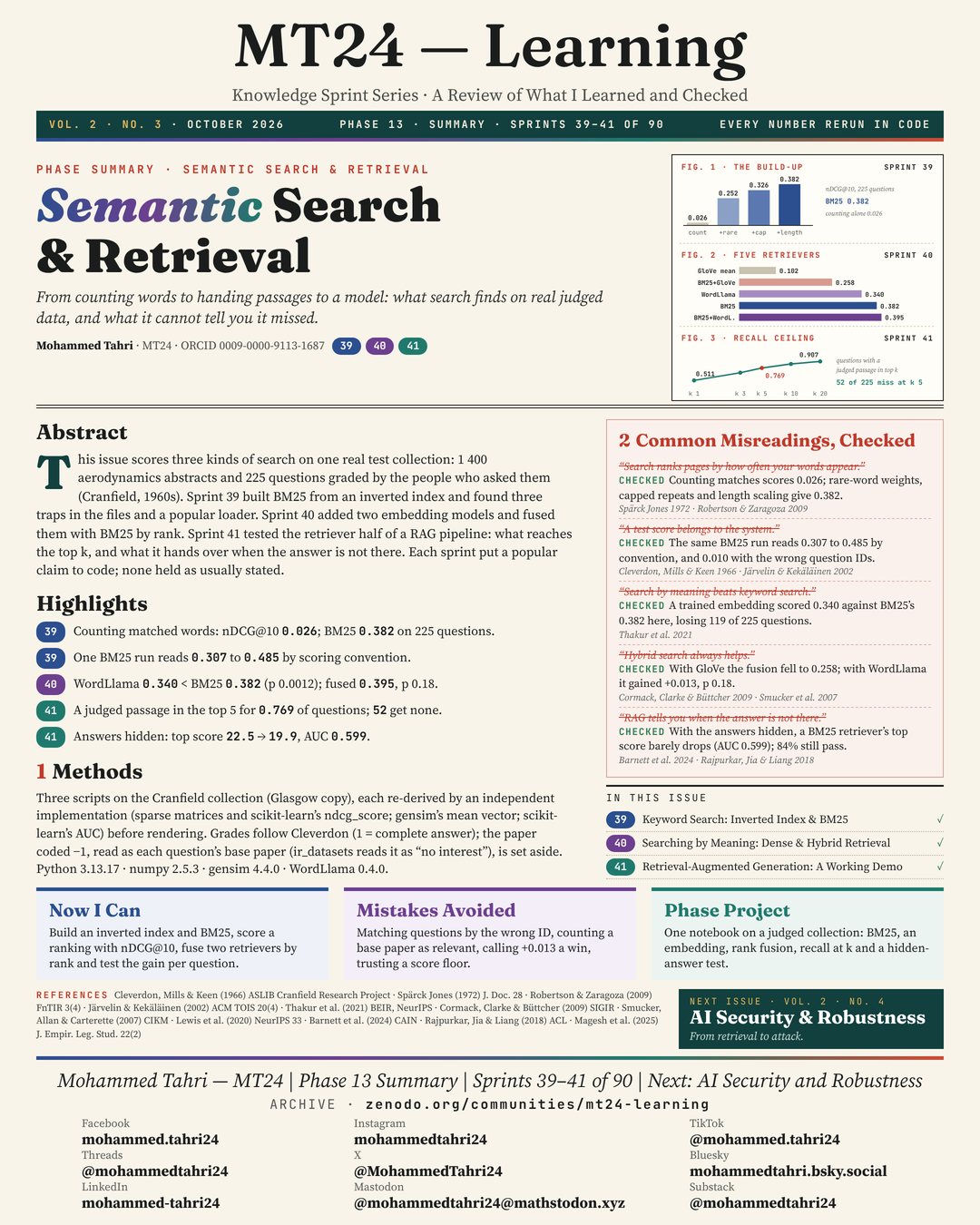
This issue scores three kinds of search on one real test collection: 1 400 aerodynamics abstracts and 225 questions graded by the people who asked them (Cranfield, 1960s). Sprint 39 built BM25 from an inverted index and found three traps in the files and a popular loader. Sprint 40 added two embedding models and fused them with BM25 by rank. Sprint 41 tested the retriever half of a RAG pipeline: what reaches the top k, and what it hands over when the answer is not there. Each sprint put a popular claim to code; none held as usually stated.
Highlights
- 39Counting matched words: nDCG@10 0.026; BM25 0.382 on 225 questions.
- 39One BM25 run reads 0.307 to 0.485 by scoring convention.
- 40WordLlama 0.340 < BM25 0.382 (p 0.0012); fused 0.395, p 0.18.
- 41A judged passage in the top 5 for 0.769 of questions; 52 get none.
- 41Answers hidden: top score 22.5 → 19.9, AUC 0.599.
Figures in words
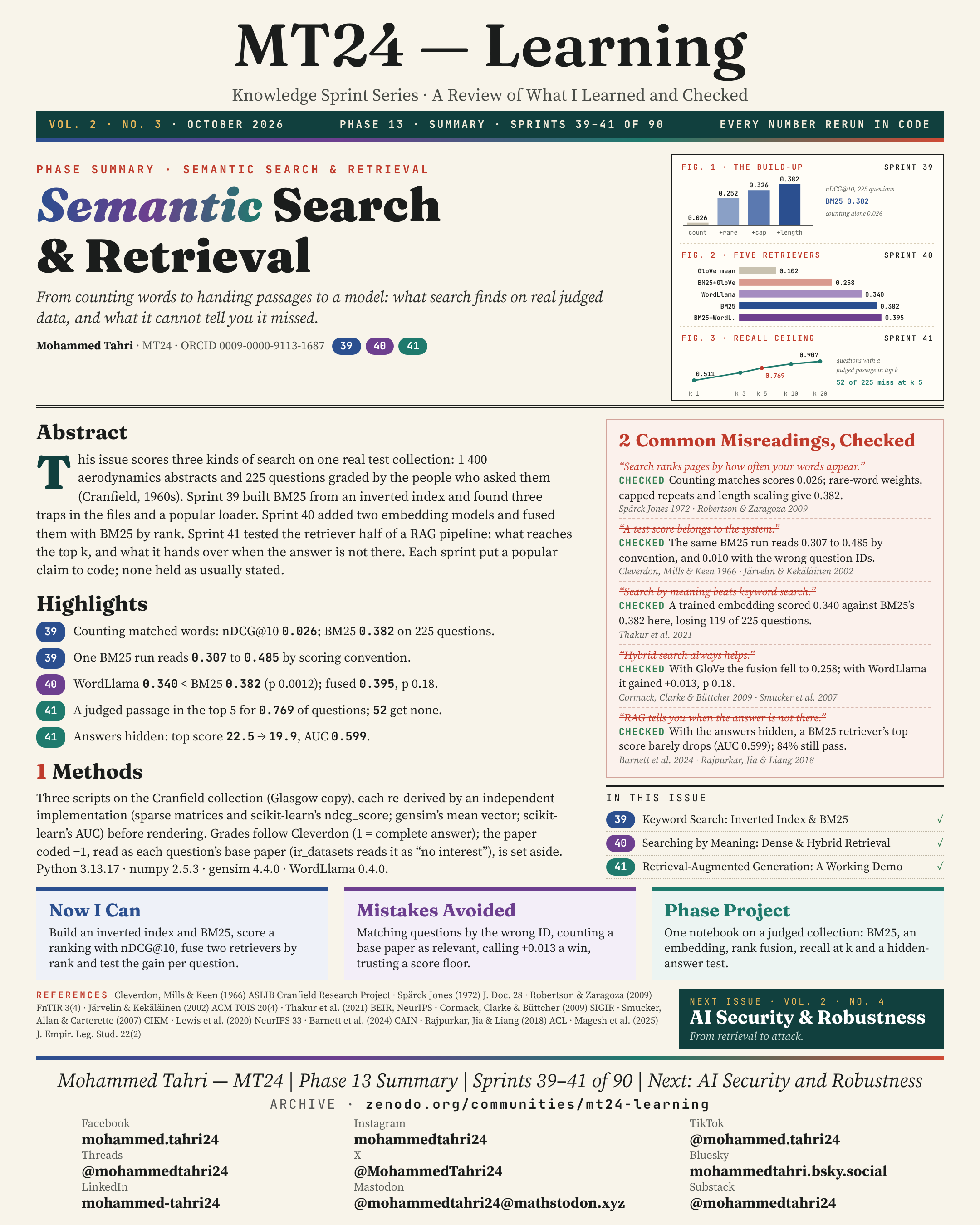
1 Fig. 1 · The build-up Sprint 39
- count 0.026 · +rare 0.252 · +cap 0.326 · +length 0.382
- nDCG@10, 225 questions
- BM25 0.382
- counting alone 0.026
2 Fig. 2 · Five retrievers Sprint 40
- GloVe mean 0.102 · BM25+GloVe 0.258 · WordLlama 0.340 · BM25 0.382 · BM25+WordL. 0.395
3 Fig. 3 · Recall ceiling Sprint 41
- k 1: 0.511 · k 5: 0.769 · k 20: 0.907 (k 3 and k 10 marked, unlabelled)
- questions with a judged passage in top k
- 52 of 225 miss at k 5
1 Methods
Three scripts on the Cranfield collection (Glasgow copy), each re-derived by an independent implementation (sparse matrices and scikit-learn’s ndcg_score; gensim’s mean vector; scikit-learn’s AUC) before rendering. Grades follow Cleverdon (1 = complete answer); the paper coded −1, read as each question’s base paper (ir_datasets reads it as “no interest”), is set aside. Python 3.13.17 · numpy 2.5.3 · gensim 4.4.0 · WordLlama 0.4.0.
2 Common Misreadings, Checked
“Search ranks pages by how often your words appear.”Checked Counting matches scores 0.026; rare-word weights, capped repeats and length scaling give 0.382.
Spärck Jones 1972 · Robertson & Zaragoza 2009
“A test score belongs to the system.”Checked The same BM25 run reads 0.307 to 0.485 by convention, and 0.010 with the wrong question IDs.
Cleverdon, Mills & Keen 1966 · Järvelin & Kekäläinen 2002
“Search by meaning beats keyword search.”Checked A trained embedding scored 0.340 against BM25’s 0.382 here, losing 119 of 225 questions.
Thakur et al. 2021
“Hybrid search always helps.”Checked With GloVe the fusion fell to 0.258; with WordLlama it gained +0.013, p 0.18.
Cormack, Clarke & Büttcher 2009 · Smucker et al. 2007
“RAG tells you when the answer is not there.”Checked With the answers hidden, a BM25 retriever’s top score barely drops (AUC 0.599); 84% still pass.
Barnett et al. 2024 · Rajpurkar, Jia & Liang 2018
In This Issue
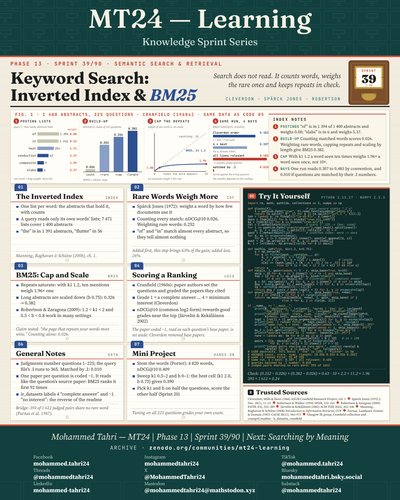 Keyword Search: Inverted Index & BM25Search does not read. It counts words, weighs the rare ones and keeps repeats in check.
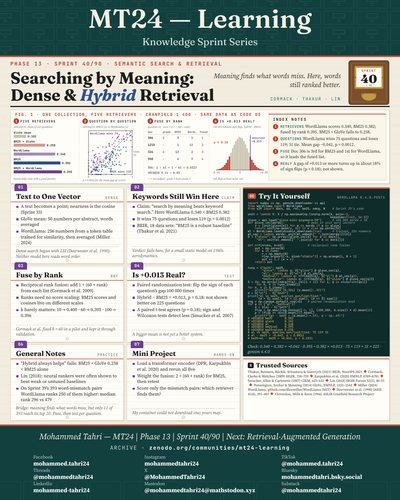 Searching by Meaning: Dense & Hybrid RetrievalMeaning finds what words miss. Here, words still ranked better.
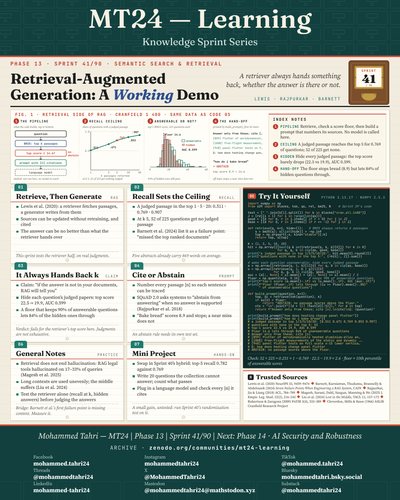 Retrieval-Augmented Generation: A Working DemoA retriever always hands something back, whether the answer is there or not.
Now I Can
Build an inverted index and BM25, score a ranking with nDCG@10, fuse two retrievers by rank and test the gain per question.
Mistakes Avoided
Matching questions by the wrong ID, counting a base paper as relevant, calling +0.013 a win, trusting a score floor.
Phase Project
One notebook on a judged collection: BM25, an embedding, rank fusion, recall at k and a hidden-answer test.
R References
- Cleverdon, Mills & Keen (1966) ASLIB Cranfield Research Project
- Spärck Jones (1972) J. Doc. 28
- Robertson & Zaragoza (2009) FnTIR 3(4)
- Järvelin & Kekäläinen (2002) ACM TOIS 20(4)
- Thakur et al. (2021) BEIR, NeurIPS
- Cormack, Clarke & Büttcher (2009) SIGIR
- Smucker, Allan & Carterette (2007) CIKM
- Lewis et al. (2020) NeurIPS 33
- Barnett et al. (2024) CAIN
- Rajpurkar, Jia & Liang (2018) ACL
- Magesh et al. (2025) J. Empir. Leg. Stud. 22(2)