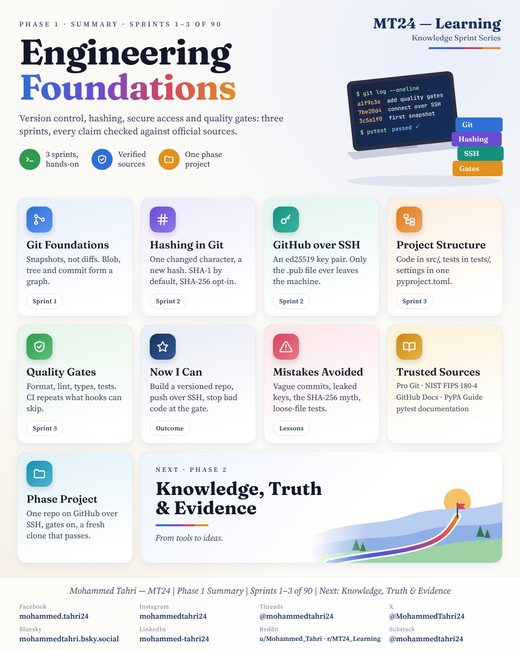
Engineering Foundations
Three sprints on the tools every project starts with: version control, content hashing and a project that checks itself.
90 sprints · 27 phases · free and open
From engineering practice to the philosophy of science, statistics and machine learning. Each sprint is one portrait page: the core concepts, a figure, commands to try, a mini project and the trusted sources behind every claim. Each phase closes with a one-page summary and one checked result.
This series is an entry point, not a full course. Each sprint opens a field that stands on its own, with its own textbooks, methods and open questions, and no set of images can cover it. The trusted sources on every sprint are where the real study continues.

The path so far
Each phase opens with every sprint image and links to its permanent, citable edition on Zenodo. Phases marked Full text also have a page for every sprint, with the whole text of its image, ready to read, search and quote.
Three sprints on the tools every project starts with: version control, content hashing and a project that checks itself.
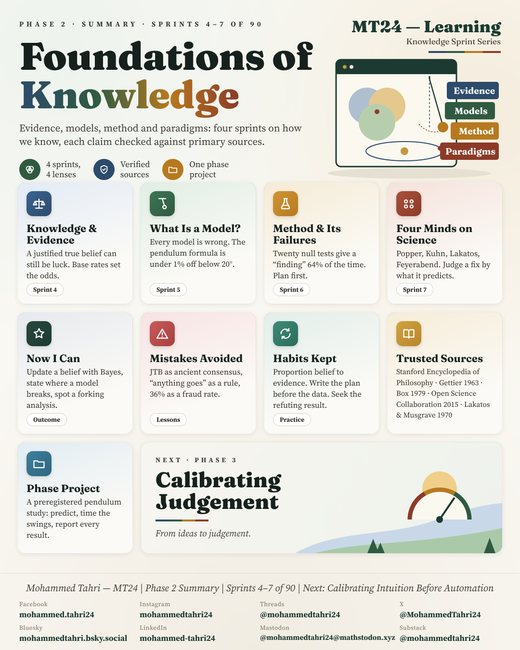
Four sprints on what knowledge is, what a model is, how the scientific method can fail and how four thinkers saw science.
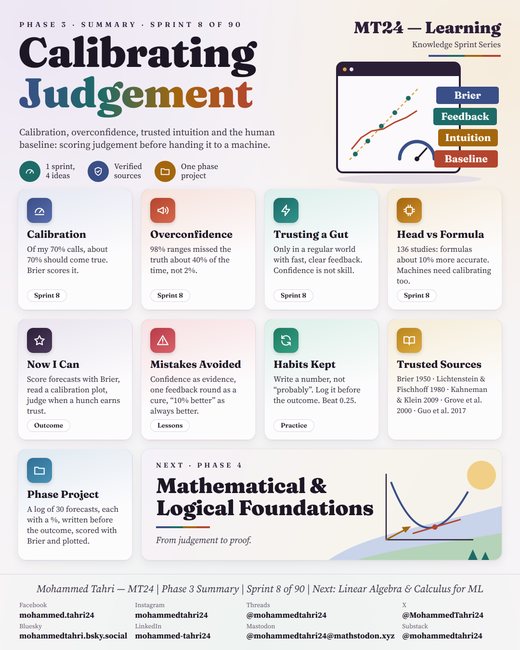
One sprint on scoring my own forecasts before trusting a machine's confidence.
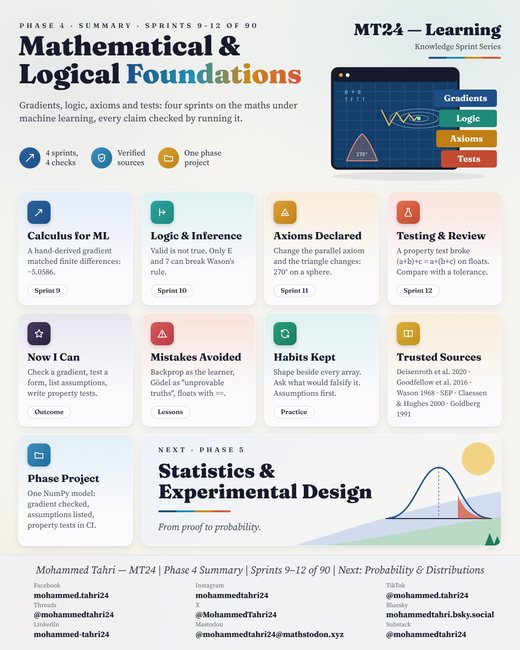
Four sprints on gradients, logic, axioms and tests: the mathematics behind every later claim.
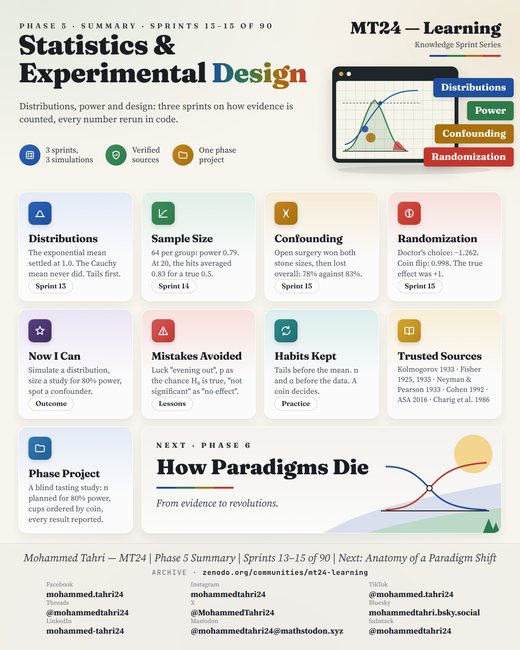
Distributions, power and design: three sprints on how evidence is counted.
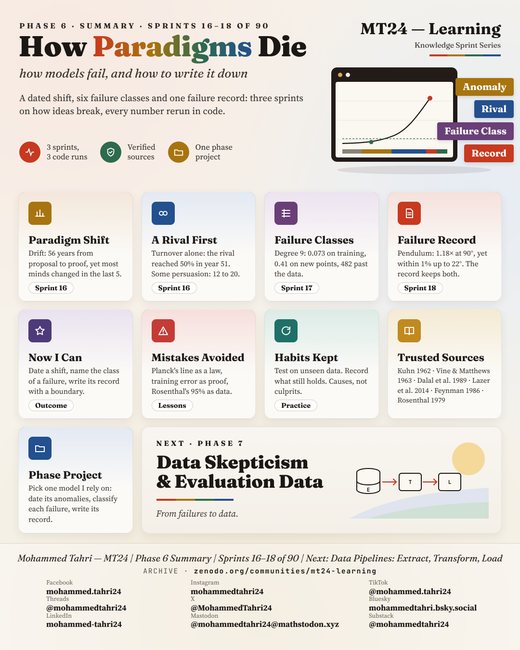
A dated shift, six failure classes and one failure record: three sprints on how ideas break.
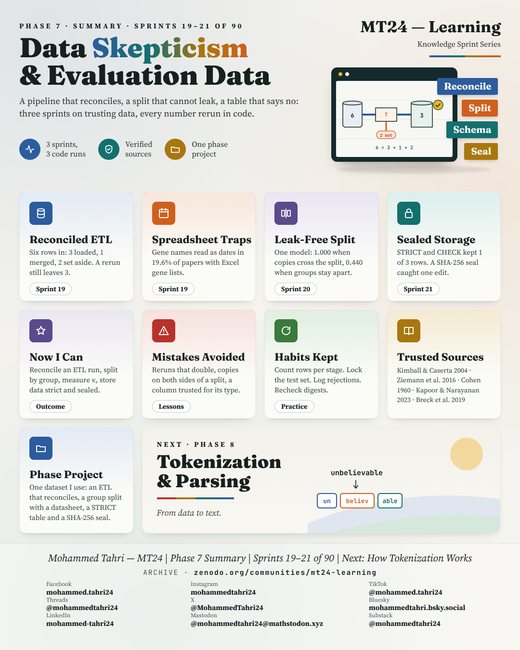
A pipeline that reconciles, a split that cannot leak, a table that says no: three sprints on trusting data.
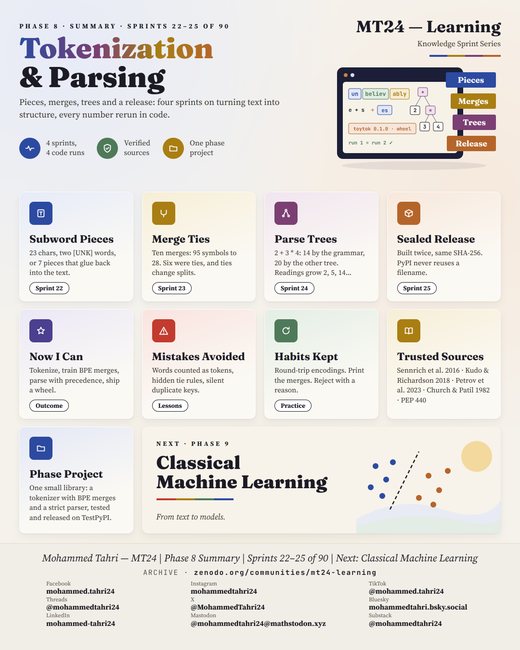
Pieces, merges, trees and a release: four sprints on turning text into structure.
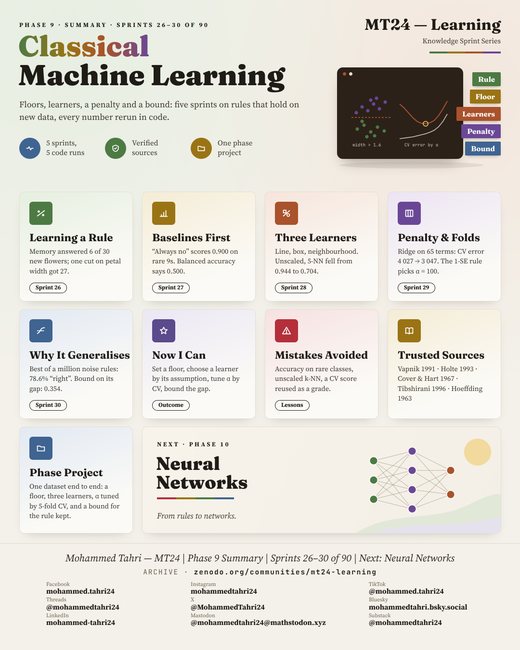
Floors, learners, a penalty and a bound: five sprints on rules that hold on new data.
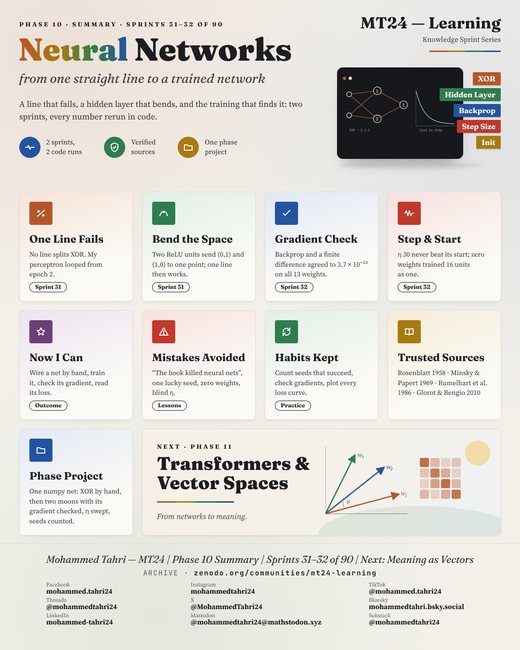
A line that fails, a hidden layer that bends, and the training that finds it.
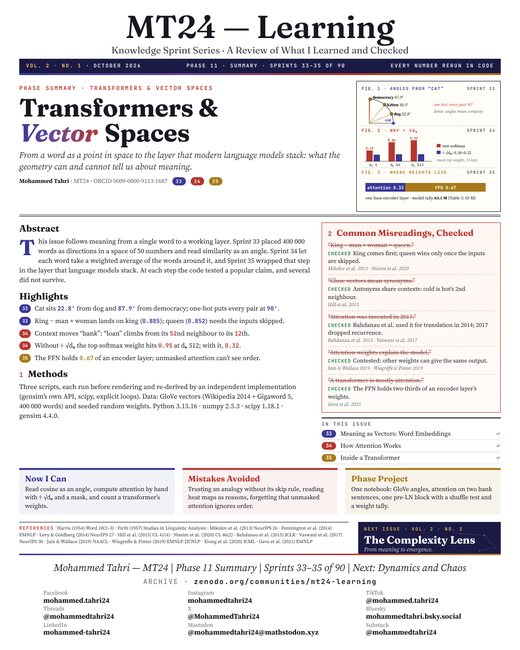
Three sprints from word vectors to attention to a full transformer layer built in code.
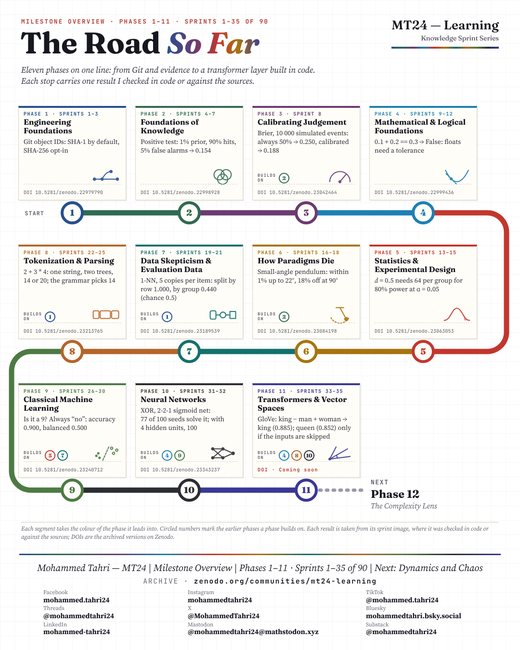
Eleven phases on one line: from Git and evidence to a transformer layer built in code. Each stop carries one result checked in code or against the sources.
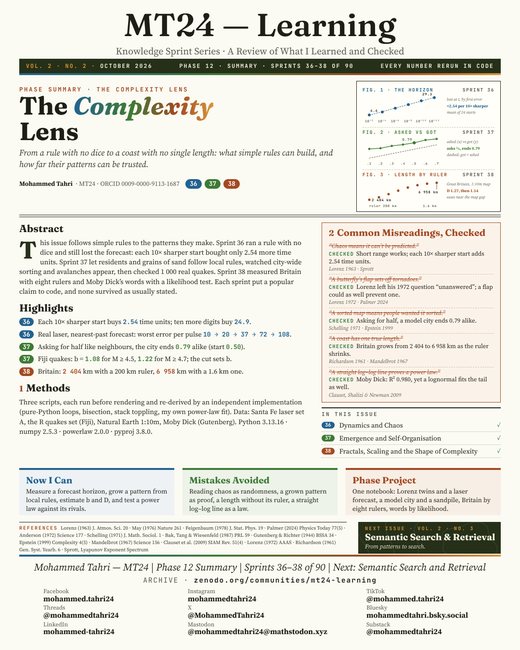
From a rule with no dice to a coast with no single length: what simple rules can build, and how far their patterns can be trusted.
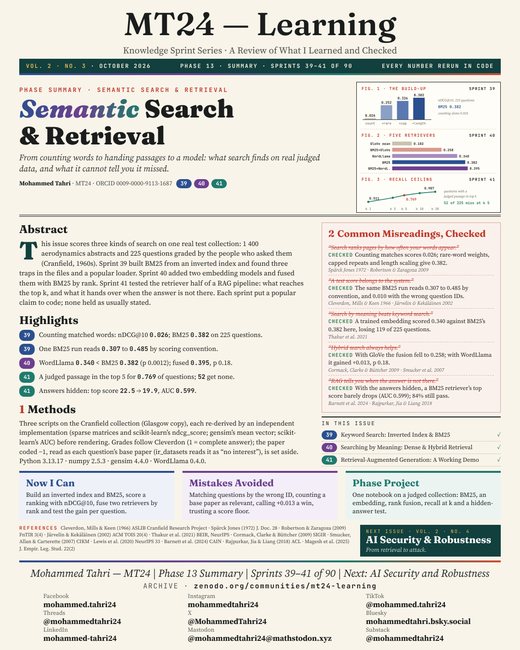
From counting words to handing passages to a model: what search finds on real judged data, and what it cannot tell you it missed.
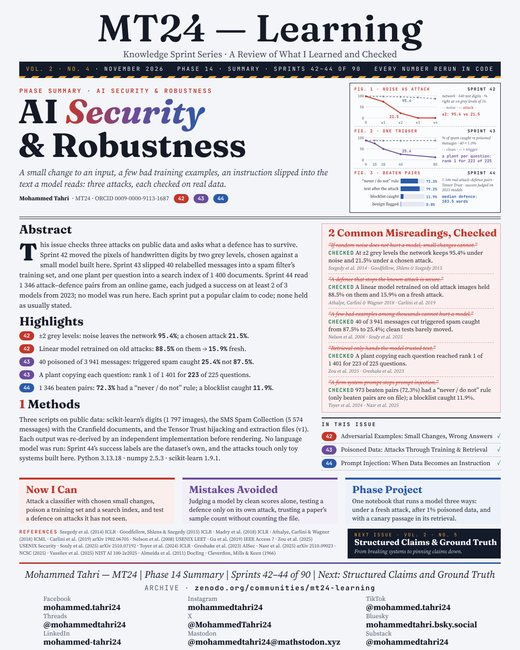
A small change to an input, a few bad training examples, an instruction slipped into the text a model reads: three attacks, each checked on real data.
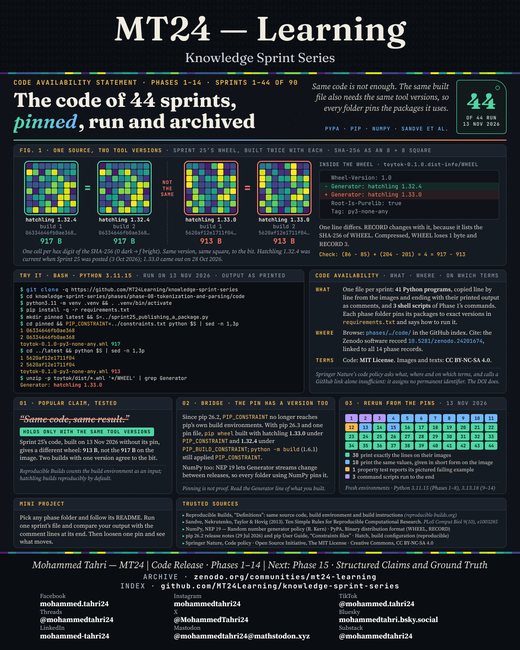
What code exists for the 44 sprints so far, where it is and on which terms, with one test: Sprint 25's package gives a 917-byte wheel with hatchling 1.32.4 and a 913-byte one with 1.33.0.
A claim's qualifiers, the votes behind its label, the sentence it is checked against and the test set that scores it: four checks on real data.
Coming next. A phase joins the index once all its images are public and its edition is archived.
One result per phase
Each phase summary opens with one result, checked in code or against the sources. Here they are, in order.
In CLIMATE-FEVER, 2,501 tied votes became NOT ENOUGH INFO under the dataset's own rule: half of all 4,930 such labels, with Krippendorff's alpha at 0.334.
Git names every object by the hash of its content: SHA-1 by default, SHA-256 opt-in.
A positive test with a 1% prior, 90% sensitivity and 5% false alarms is right only 15.4% of the time.
Brier score on 10,000 simulated events: always saying 50% scores 0.250, honest forecasts 0.188.
0.1 + 0.2 == 0.3 is False in floating point: comparisons need a tolerance.
An effect of d = 0.5 needs 64 people per group for 80% power at α = 0.05.
The small-angle pendulum formula stays within 1% up to 22° and is 18% off at 90°.
With copied items in the data, a random split scores 1.000 and a split by group 0.440, close to chance.
2 + 3 * 4: one string, two trees; the grammar picks 14.
“Is it a 9?” Always answering no scores 0.900 accuracy but 0.500 balanced accuracy.
XOR on a bare 2-2-1 sigmoid network: 77 of 100 random starts solve it; with four hidden units, all 100.
king − man + woman returns king itself (0.885); queen (0.852) appears only when the input words are skipped.
In a simulation of the Lorenz system, each 10× sharper start buys 2.54 more time units of forecast on average over 24 starts.
On the Cranfield collection, counting words alone scores nDCG@10 0.026; BM25 scores 0.382.
On 540 handwritten digits, random noise of ±2 grey levels leaves a small network at 95.4%; a chosen 10-step attack of the same size leaves 21.5%.
In CLIMATE-FEVER, 2,501 tied votes became NOT ENOUGH INFO under the dataset's own rule: half of all 4,930 such labels, with Krippendorff's alpha at 0.334.
How a sprint works
Every sprint image follows the same idea, even as the visual style changes from phase to phase. Each phase then ends with a one-page summary: what each sprint taught, what I can now do, mistakes avoided, and one phase project that ties the sprints together.
The idea of the sprint in short cards, written so each one can be checked against its sources.
The main idea drawn, with real numbers where there are any (from Phase 2 onward).
Commands or a short program you can run yourself, shown with its real output. Each phase page links the same code as files, with the versions that reproduce it.
One small piece of work to apply the sprint on your own.
Books, papers and official documentation, so every claim can be checked against its origin.
Cite
Each phase has its own DOI on Zenodo, and its page on GitHub gives the full reference. For the latest phase:
Tahri, M. (2026). MT24 Learning — Knowledge Sprint Series, Phase 15: Structured Claims & Ground Truth (Version 1.0) [Educational resource]. Zenodo. https://doi.org/10.5281/zenodo.24387974
All editions on Zenodo Cite this repository on GitHub ORCID 0009-0000-9113-1687