
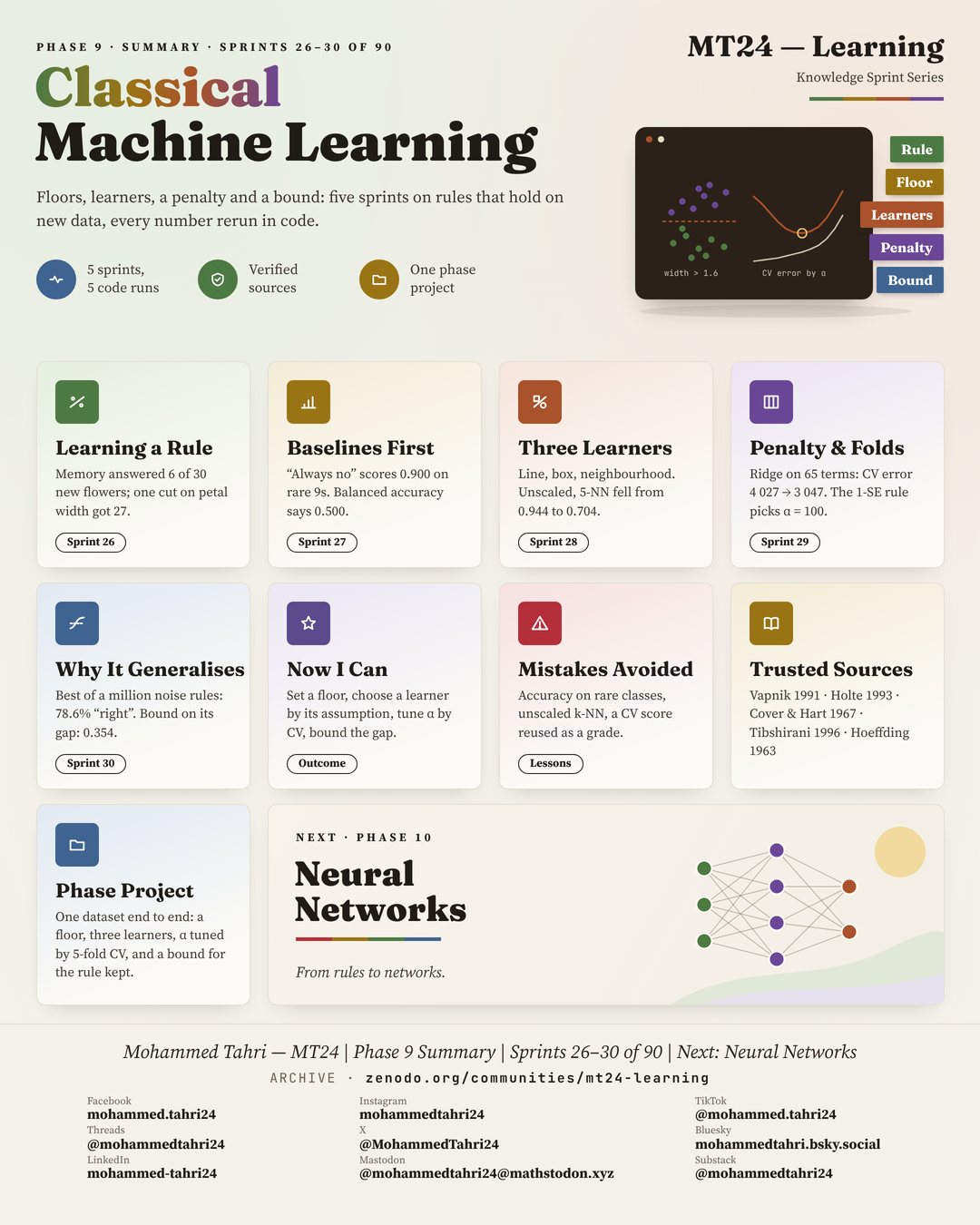
Figure in words
- A dark code window with two small plots
- purple dots above and green dots below a dashed line · width > 1.6
- a U-shaped error curve with its lowest point ringed, above a rising lighter curve · CV error by α
- five tags beside it: Rule · Floor · Learners · Penalty · Bound
The Sprints
Learning a Rule
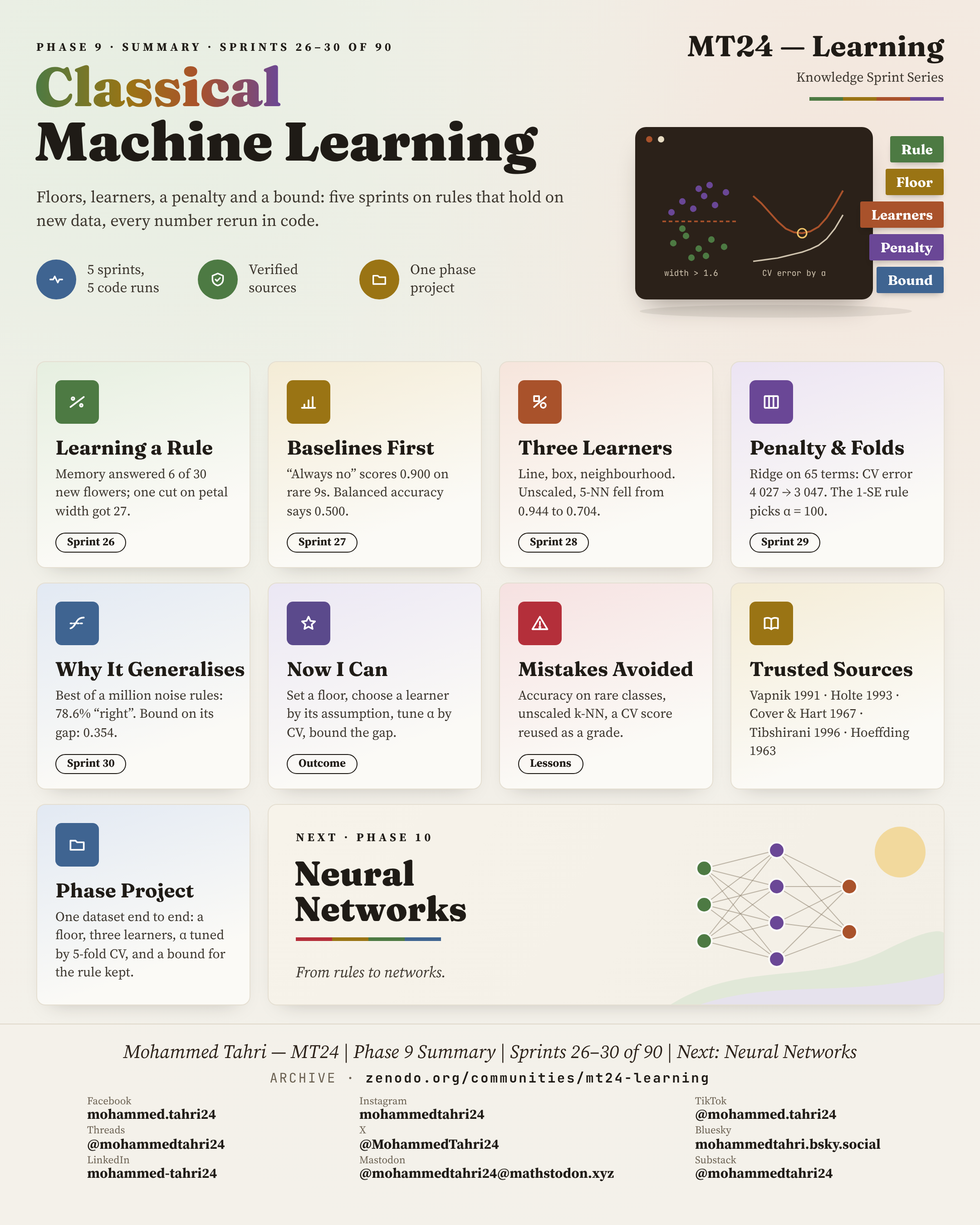
Memory answered 6 of 30 new flowers; one cut on petal width got 27.
Sprint 26Baselines First
“Always no” scores 0.900 on rare 9s. Balanced accuracy says 0.500.
Sprint 27Three Learners
Line, box, neighbourhood. Unscaled, 5-NN fell from 0.944 to 0.704.
Sprint 28Penalty & Folds
Ridge on 65 terms: CV error 4 027 → 3 047. The 1-SE rule picks α = 100.
Sprint 29Why It Generalises
Best of a million noise rules: 78.6% “right”. Bound on its gap: 0.354.
Sprint 30Now I Can Outcome
Set a floor, choose a learner by its assumption, tune α by CV, bound the gap.
Mistakes Avoided Lessons
Accuracy on rare classes, unscaled k-NN, a CV score reused as a grade.
Phase Project
One dataset end to end: a floor, three learners, α tuned by 5-fold CV, and a bound for the rule kept.
R Trusted Sources
The Sprint Pages
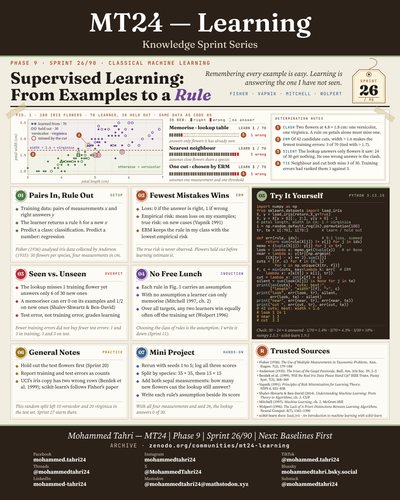 Supervised Learning: From Examples to a RuleRemembering every example is easy. Learning is answering the one I have not seen.
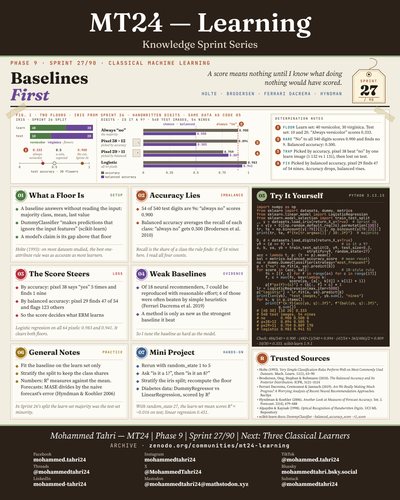 Baselines FirstA score means nothing until I know what doing nothing would have scored.
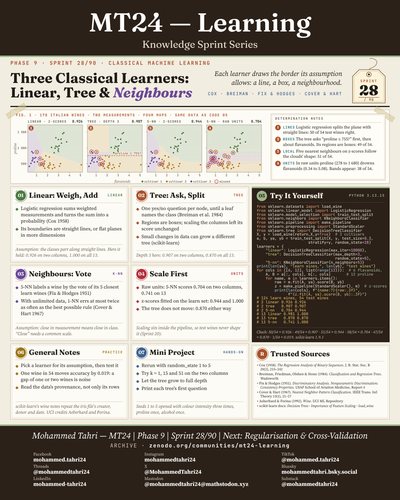 Three Classical Learners: Linear, Tree & NeighboursEach learner draws the border its assumption allows: a line, a box, a neighbourhood.
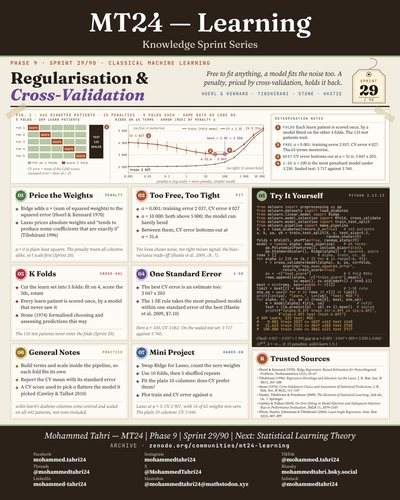 Regularisation & Cross-ValidationFree to fit anything, a model fits the noise too. A penalty, priced by cross-validation, holds it back.
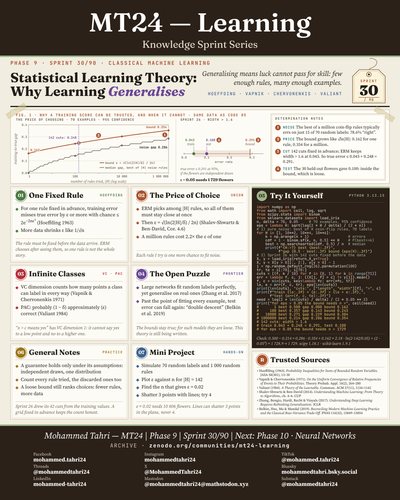 Statistical Learning Theory: Why Learning GeneralisesGeneralising means luck cannot pass for skill: few enough rules, many enough examples.