
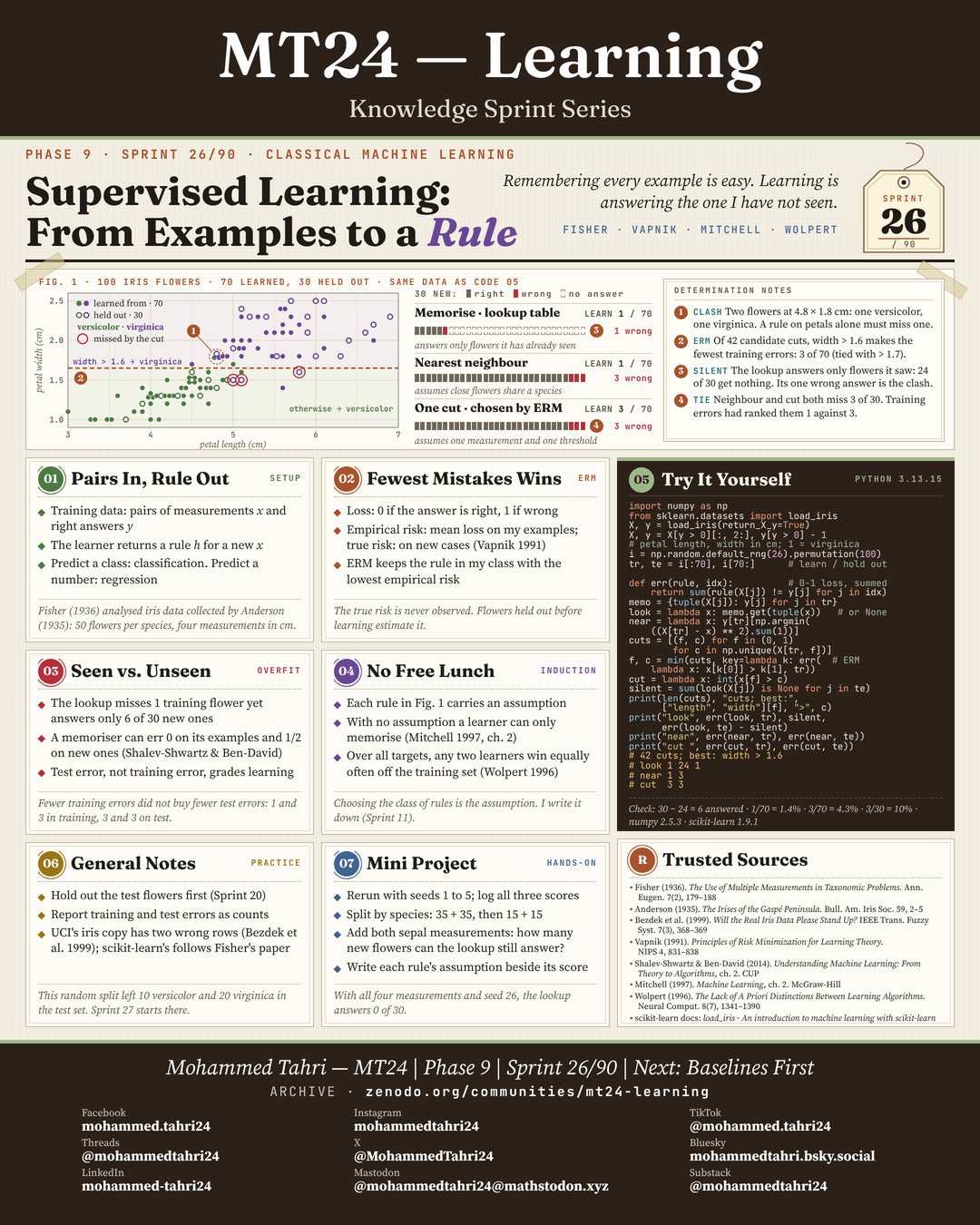

Fig. 1 in words
100 iris flowers · 70 learned, 30 held out · same data as code 05
1 Petal length · petal width
- petal length (cm), 3 to 7 · petal width (cm), 1.0 to 2.5
- filled dots: learned from · 70 · hollow dots: held out · 30
- green: versicolor · purple: virginica
- red ring: missed by the cut
- dashed line: width > 1.6 → virginica · below it: otherwise → versicolor
- ① a dashed circle round a green and a purple dot at the same spot · ② the dashed line of the cut
2 30 new: right · wrong · no answer
- Memorise · lookup table · learn 1 / 70 · 1 wrong ③ · a row of mostly empty squares: no answer
- answers only flowers it has already seen
- Nearest neighbour · learn 1 / 70 · 3 wrong
- assumes close flowers share a species
- One cut · chosen by ERM · learn 3 / 70 · 3 wrong ④
- assumes one measurement and one threshold
01 Pairs In, Rule Out Setup
- Training data: pairs of measurements x and right answers y
- The learner returns a rule h for a new x
- Predict a class: classification. Predict a number: regression
Fisher (1936) analysed iris data collected by Anderson (1935): 50 flowers per species, four measurements in cm.
02 Fewest Mistakes Wins ERM
- Loss: 0 if the answer is right, 1 if wrong
- Empirical risk: mean loss on my examples; true risk: on new cases (Vapnik 1991)
- ERM keeps the rule in my class with the lowest empirical risk
The true risk is never observed. Flowers held out before learning estimate it.
03 Seen vs. Unseen Overfit
- The lookup misses 1 training flower yet answers only 6 of 30 new ones
- A memoriser can err 0 on its examples and 1/2 on new ones (Shalev-Shwartz & Ben-David)
- Test error, not training error, grades learning
Fewer training errors did not buy fewer test errors: 1 and 3 in training, 3 and 3 on test.
04 No Free Lunch Induction
- Each rule in Fig. 1 carries an assumption
- With no assumption a learner can only memorise (Mitchell 1997, ch. 2)
- Over all targets, any two learners win equally often off the training set (Wolpert 1996)
Choosing the class of rules is the assumption. I write it down (Sprint 11).
05 Try It Yourself PYTHON 3.13.15
sprint26_supervised_learning_from_examples_to_a_rule.py
import numpy as np
from sklearn.datasets import load_iris
X, y = load_iris(return_X_y=True)
X, y = X[y > 0][:, 2:], y[y > 0] - 1
# petal length, width in cm; 1 = virginica
i = np.random.default_rng(26).permutation(100)
tr, te = i[:70], i[70:]      # learn / hold out

def err(rule, idx):          # 0-1 loss, summed
    return sum(rule(X[j]) != y[j] for j in idx)
memo = {tuple(X[j]): y[j] for j in tr}
look = lambda x: memo.get(tuple(x))   # or None
near = lambda x: y[tr][np.argmin(
    ((X[tr] - x) ** 2).sum(1))]
cuts = [(f, c) for f in (0, 1)
        for c in np.unique(X[tr, f])]
f, c = min(cuts, key=lambda k: err(  # ERM
    lambda x: x[k[0]] > k[1], tr))
cut = lambda x: int(x[f] > c)
silent = sum(look(X[j]) is None for j in te)
print(len(cuts), "cuts; best:",
      ["length", "width"][f], ">", c)
print("look", err(look, tr), silent,
      err(look, te) - silent)
print("near", err(near, tr), err(near, te))
print("cut ", err(cut, tr), err(cut, te))
Output, as printed on the image
42 cuts; best: width > 1.6
look 1 24 1
near 1 3
cut  3 3
Run it. sprint26_supervised_learning_from_examples_to_a_rule.py · versions, data and steps
Check: 30 − 24 = 6 answered · 1/70 = 1.4% · 3/70 = 4.3% · 3/30 = 10% · numpy 2.5.3 · scikit-learn 1.9.1
06 General Notes Practice
- Hold out the test flowers first (Sprint 20)
- Report training and test errors as counts
- UCI's iris copy has two wrong rows (Bezdek et al. 1999); scikit-learn's follows Fisher's paper
This random split left 10 versicolor and 20 virginica in the test set. Sprint 27 starts there.
07 Mini Project Hands-on
- Rerun with seeds 1 to 5; log all three scores
- Split by species: 35 + 35, then 15 + 15
- Add both sepal measurements: how many new flowers can the lookup still answer?
- Write each rule's assumption beside its score
With all four measurements and seed 26, the lookup answers 0 of 30.
R Trusted Sources
- Fisher (1936). The Use of Multiple Measurements in Taxonomic Problems. Ann. Eugen. 7(2), 179–188
- Anderson (1935). The Irises of the Gaspé Peninsula. Bull. Am. Iris Soc. 59, 2–5
- Bezdek et al. (1999). Will the Real Iris Data Please Stand Up? IEEE Trans. Fuzzy Syst. 7(3), 368–369
- Vapnik (1991). Principles of Risk Minimization for Learning Theory. NIPS 4, 831–838
- Shalev-Shwartz & Ben-David (2014). Understanding Machine Learning: From Theory to Algorithms, ch. 2. CUP
- Mitchell (1997). Machine Learning, ch. 2. McGraw-Hill
- Wolpert (1996). The Lack of A Priori Distinctions Between Learning Algorithms. Neural Comput. 8(7), 1341–1390
- scikit-learn docs: load_iris · An introduction to machine learning with scikit-learn