
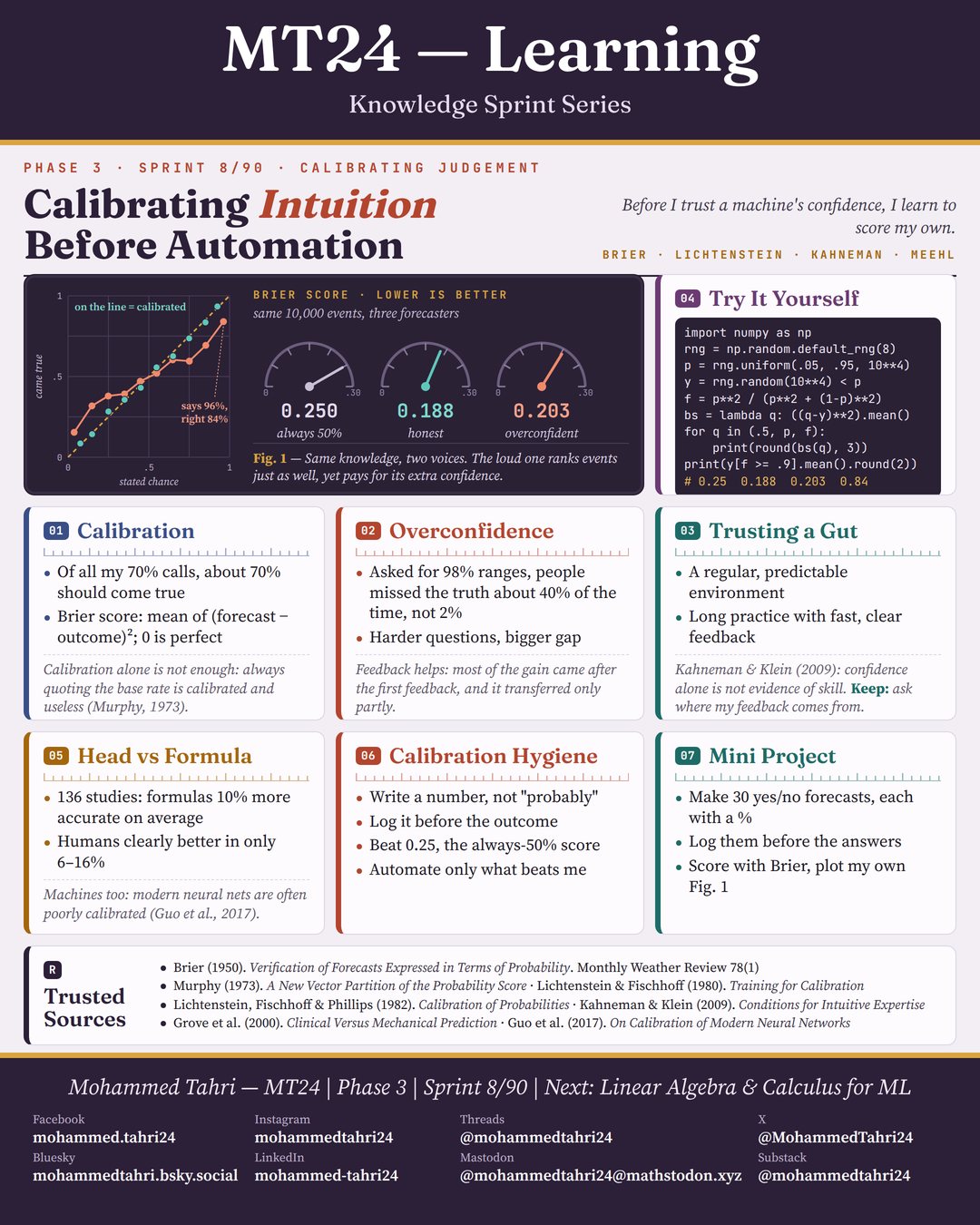
Fig. 1 in words
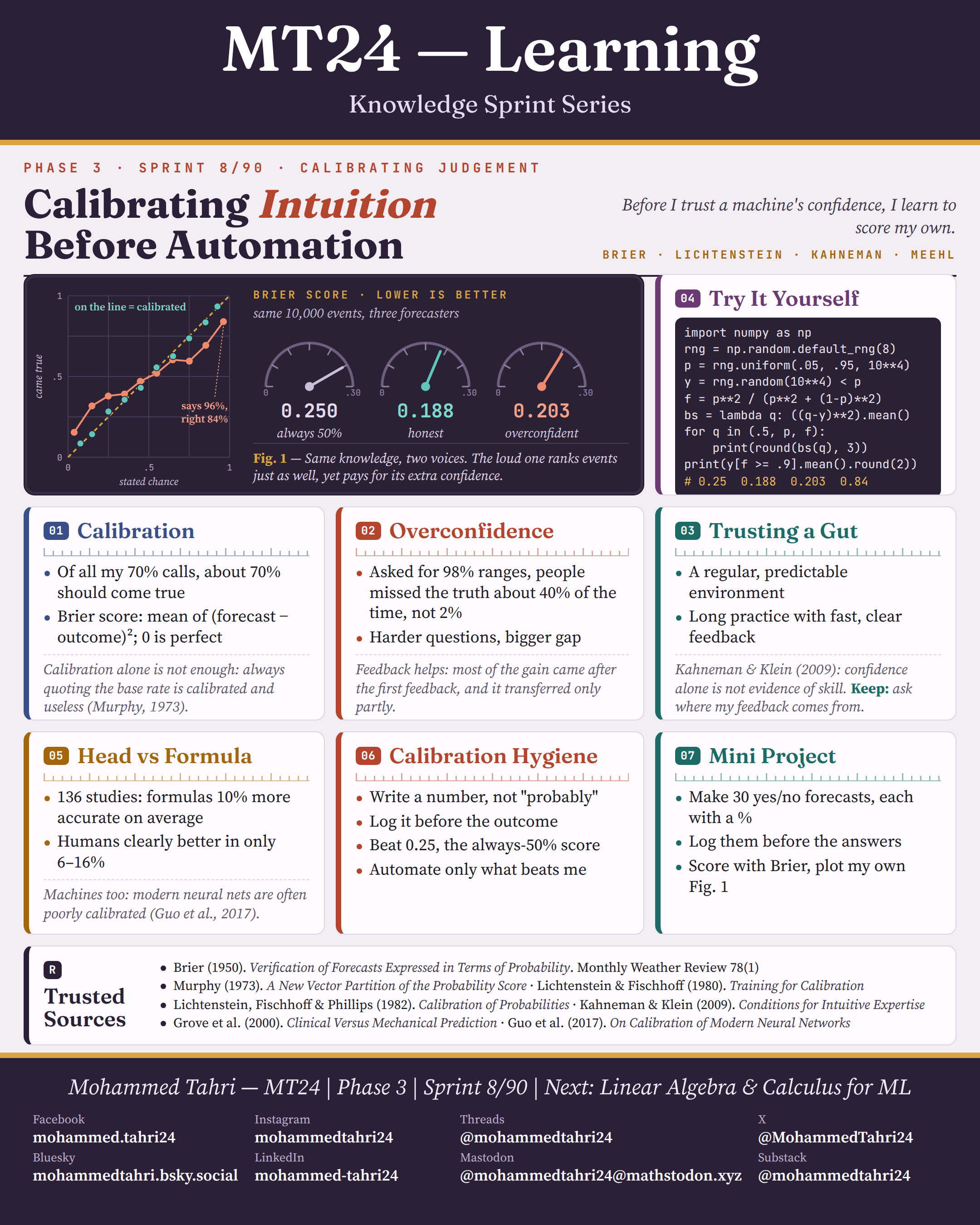
Same knowledge, two voices. The loud one ranks events just as well, yet pays for its extra confidence.
1 On the line = calibrated
- came true (0 to 1) against stated chance (0 to 1); dashed diagonal: on the line = calibrated
- honest forecaster (green dots): close to the line
- overconfident forecaster (orange line): above the line at low stated chances, below it at high ones
- says 96%, right 84%
2 Brier score · lower is better
- same 10,000 events, three forecasters
- 0.250 · always 50%
- 0.188 · honest
- 0.203 · overconfident
- each gauge runs from 0 to .30
01 Calibration
- Of all my 70% calls, about 70% should come true
- Brier score: mean of (forecast − outcome)²; 0 is perfect
Calibration alone is not enough: always quoting the base rate is calibrated and useless (Murphy, 1973).
02 Overconfidence
- Asked for 98% ranges, people missed the truth about 40% of the time, not 2%
- Harder questions, bigger gap
Feedback helps: most of the gain came after the first feedback, and it transferred only partly.
03 Trusting a Gut
- A regular, predictable environment
- Long practice with fast, clear feedback
Kahneman & Klein (2009): confidence alone is not evidence of skill. Keep: ask where my feedback comes from.
04 Try It Yourself
sprint08_calibrating_intuition_before_automation.py
import numpy as np
rng = np.random.default_rng(8)
p = rng.uniform(.05, .95, 10**4)
y = rng.random(10**4) < p
f = p**2 / (p**2 + (1-p)**2)
bs = lambda q: ((q-y)**2).mean()
for q in (.5, p, f):
    print(round(bs(q), 3))
print(y[f >= .9].mean().round(2))
Output, as printed on the image
0.25 0.188 0.203 0.84Run it. sprint08_calibrating_intuition_before_automation.py · versions, data and steps
05 Head vs Formula
- 136 studies: formulas 10% more accurate on average
- Humans clearly better in only 6–16%
Machines too: modern neural nets are often poorly calibrated (Guo et al., 2017).
06 Calibration Hygiene
- Write a number, not "probably"
- Log it before the outcome
- Beat 0.25, the always-50% score
- Automate only what beats me
07 Mini Project
- Make 30 yes/no forecasts, each with a %
- Log them before the answers
- Score with Brier, plot my own Fig. 1
R Trusted Sources
- Brier (1950). Verification of Forecasts Expressed in Terms of Probability. Monthly Weather Review 78(1)
- Murphy (1973). A New Vector Partition of the Probability Score
- Lichtenstein & Fischhoff (1980). Training for Calibration
- Lichtenstein, Fischhoff & Phillips (1982). Calibration of Probabilities
- Kahneman & Klein (2009). Conditions for Intuitive Expertise
- Grove et al. (2000). Clinical Versus Mechanical Prediction
- Guo et al. (2017). On Calibration of Modern Neural Networks