
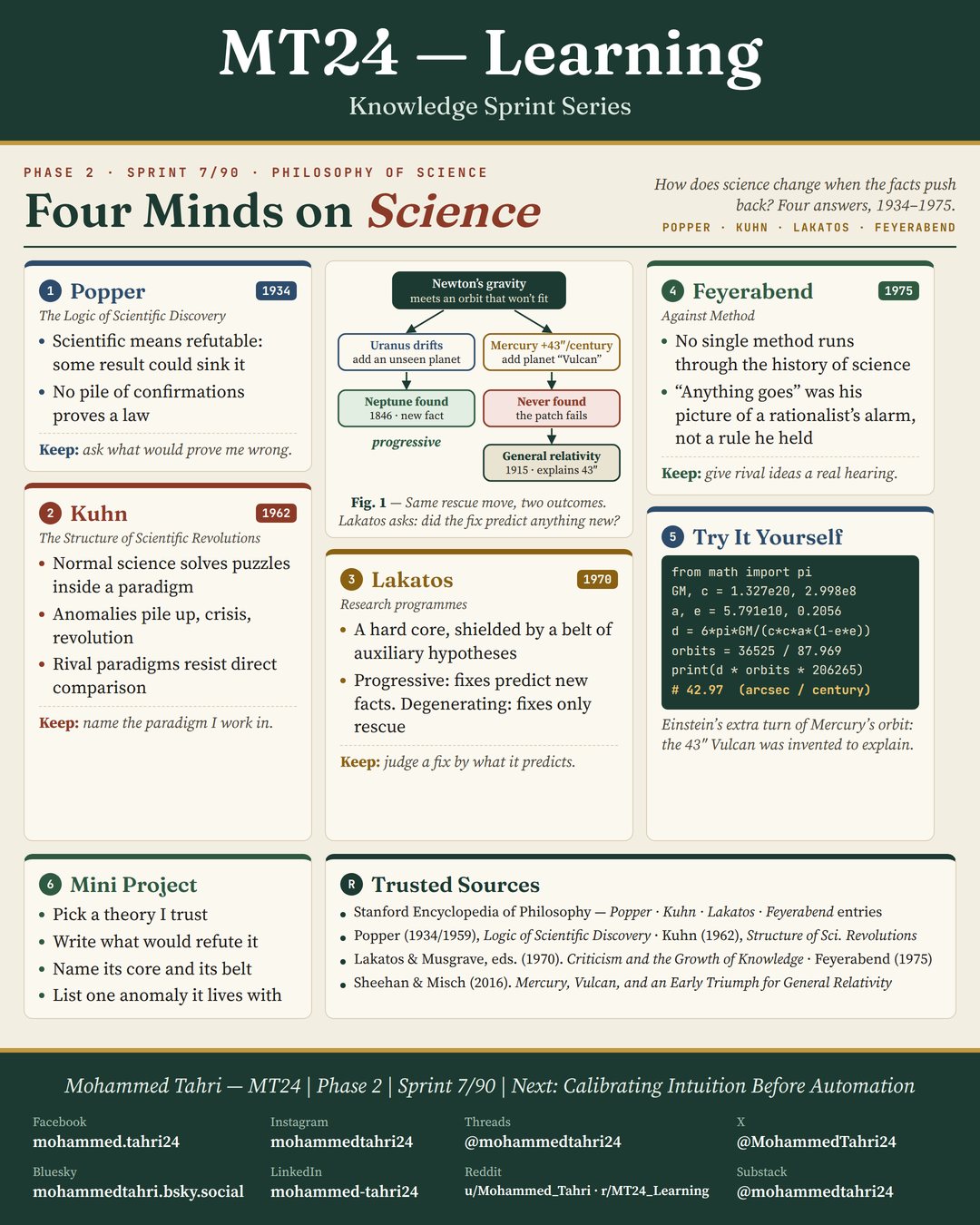
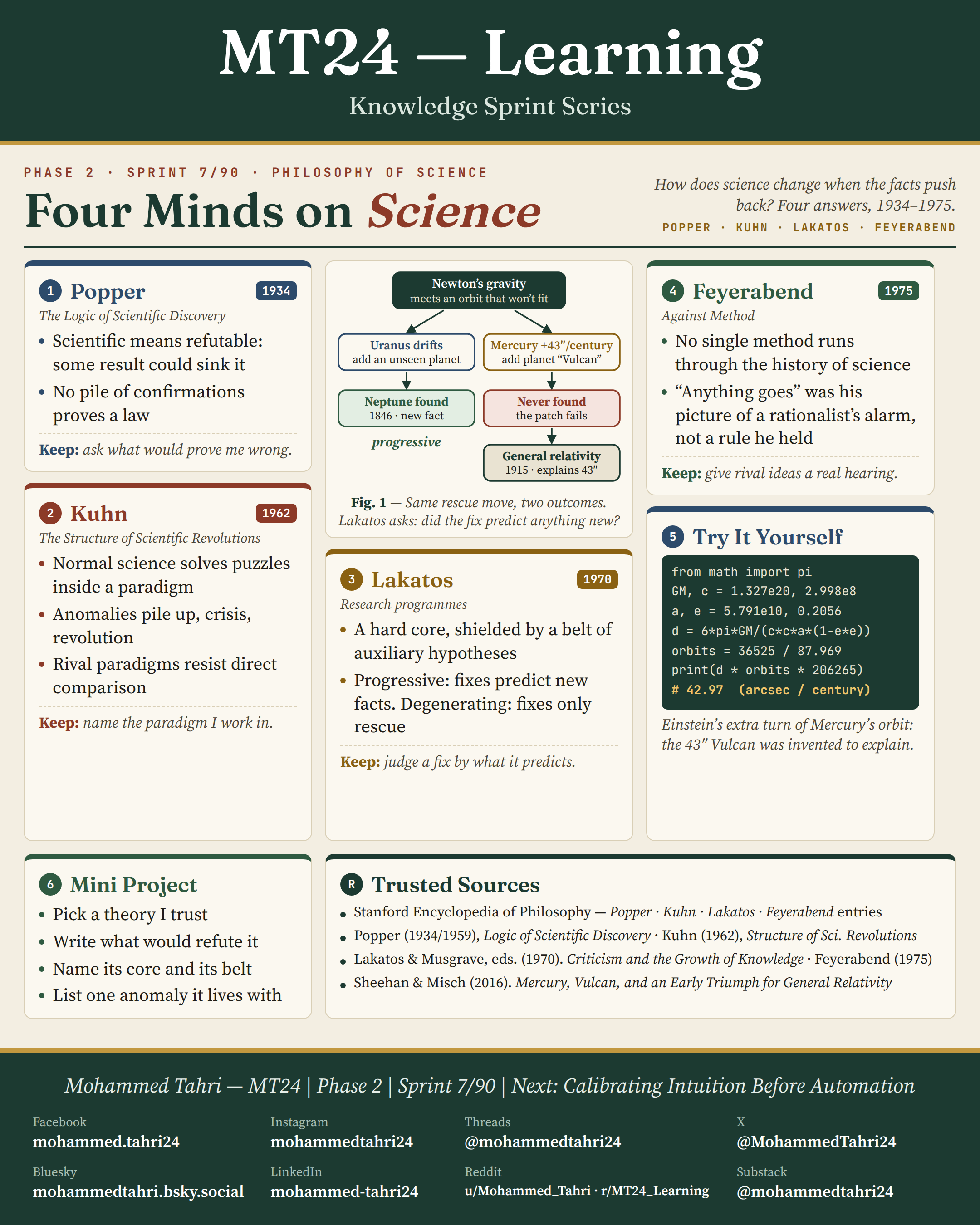
Fig. 1 in words
Same rescue move, two outcomes. Lakatos asks: did the fix predict anything new?
- top: Newton’s gravity · meets an orbit that won’t fit
- left branch: Uranus drifts · add an unseen planet → Neptune found · 1846 · new fact
- under the left branch: progressive
- right branch: Mercury +43″/century · add planet “Vulcan” → Never found · the patch fails → General relativity · 1915 · explains 43″
1 Popper 1934
The Logic of Scientific Discovery
- Scientific means refutable: some result could sink it
- No pile of confirmations proves a law
Keep: ask what would prove me wrong.
2 Kuhn 1962
The Structure of Scientific Revolutions
- Normal science solves puzzles inside a paradigm
- Anomalies pile up, crisis, revolution
- Rival paradigms resist direct comparison
Keep: name the paradigm I work in.
3 Lakatos 1970
Research programmes
- A hard core, shielded by a belt of auxiliary hypotheses
- Progressive: fixes predict new facts. Degenerating: fixes only rescue
Keep: judge a fix by what it predicts.
4 Feyerabend 1975
Against Method
- No single method runs through the history of science
- “Anything goes” was his picture of a rationalist’s alarm, not a rule he held
Keep: give rival ideas a real hearing.
5 Try It Yourself
sprint07_four_minds_on_science.py
from math import pi
GM, c = 1.327e20, 2.998e8
a, e = 5.791e10, 0.2056
d = 6*pi*GM/(c*c*a*(1-e*e))
orbits = 36525 / 87.969
print(d * orbits * 206265)
Output, as printed on the image
42.97 (arcsec / century)Run it. sprint07_four_minds_on_science.py · versions, data and steps
- Einstein’s extra turn of Mercury’s orbit: the 43″ Vulcan was invented to explain.
6 Mini Project
- Pick a theory I trust
- Write what would refute it
- Name its core and its belt
- List one anomaly it lives with
R Trusted Sources
- Stanford Encyclopedia of Philosophy — Popper
- Kuhn
- Lakatos
- Feyerabend entries
- Popper (1934/1959), Logic of Scientific Discovery
- Kuhn (1962), Structure of Sci. Revolutions
- Lakatos & Musgrave, eds. (1970). Criticism and the Growth of Knowledge
- Feyerabend (1975)
- Sheehan & Misch (2016). Mercury, Vulcan, and an Early Triumph for General Relativity