
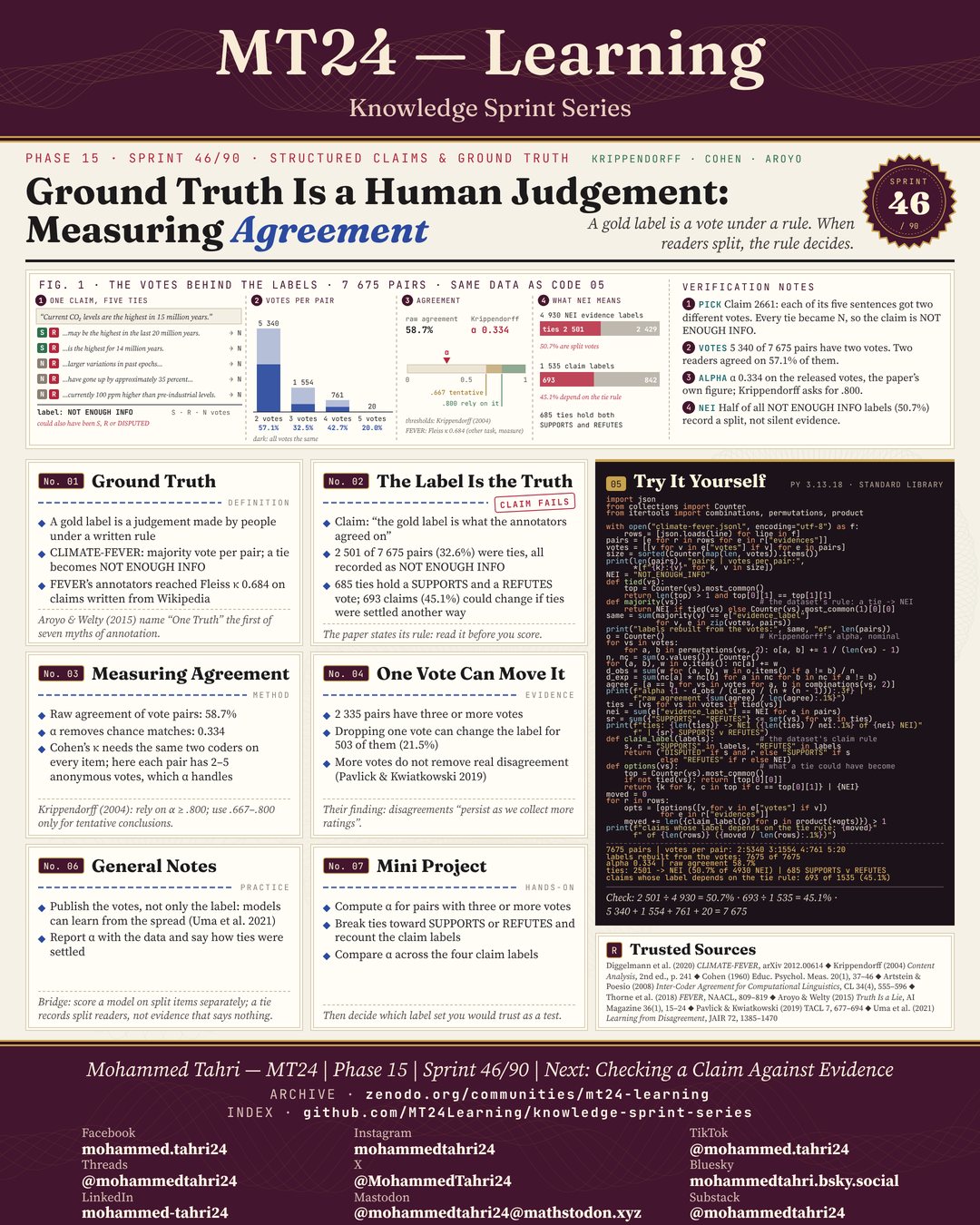

Fig. 1 in words
The votes behind the labels · 7 675 pairs · same data as code 05
1 One claim, five ties
- “Current CO₂ levels are the highest in 15 million years.”
- S R · …may be the highest in the last 20 million years. → N
- S R · …is the highest for 14 million years. → N
- N R · …larger variations in past epochs… → N
- N R · …have gone up by approximately 35 percent… → N
- N R · …currently 100 ppm higher than pre-industrial levels. → N
- label: NOT ENOUGH INFO · S · R · N votes
- could also have been S, R or DISPUTED
2 Votes per pair
- 2 votes: 5 340 · 57.1%
- 3 votes: 1 554 · 32.5%
- 4 votes: 761 · 42.7%
- 5 votes: 20 · 20.0%
- dark: all votes the same
3 Agreement
- raw agreement 58.7% · Krippendorff α 0.334
- α marked on a 0 to 1 scale: .667 tentative · .800 rely on it
- thresholds: Krippendorff (2004)
- FEVER: Fleiss κ 0.684 (other task, measure)
4 What NEI means
- 4 930 NEI evidence labels: ties 2 501 · 2 429
- 50.7% are split votes
- 1 535 claim labels: 693 · 842
- 45.1% depend on the tie rule
- 685 ties hold both SUPPORTS and REFUTES
01 Ground Truth Definition
- A gold label is a judgement made by people under a written rule
- CLIMATE-FEVER: majority vote per pair; a tie becomes NOT ENOUGH INFO
- FEVER’s annotators reached Fleiss κ 0.684 on claims written from Wikipedia
Aroyo & Welty (2015) name “One Truth” the first of seven myths of annotation.
02 The Label Is the Truth Claim fails
- Claim: “the gold label is what the annotators agreed on”
- 2 501 of 7 675 pairs (32.6%) were ties, all recorded as NOT ENOUGH INFO
- 685 ties hold a SUPPORTS and a REFUTES vote; 693 claims (45.1%) could change if ties were settled another way
The paper states its rule: read it before you score.
03 Measuring Agreement Method
- Raw agreement of vote pairs: 58.7%
- α removes chance matches: 0.334
- Cohen’s κ needs the same two coders on every item; here each pair has 2–5 anonymous votes, which α handles
Krippendorff (2004): rely on α ≥ .800; use .667–.800 only for tentative conclusions.
04 One Vote Can Move It Evidence
- 2 335 pairs have three or more votes
- Dropping one vote can change the label for 503 of them (21.5%)
- More votes do not remove real disagreement (Pavlick & Kwiatkowski 2019)
Their finding: disagreements “persist as we collect more ratings”.
05 Try It Yourself PY 3.13.18 · STANDARD LIBRARY
sprint46_ground_truth_is_a_human_judgement_measuring_agreement.py
import json
from collections import Counter
from itertools import combinations, permutations, product

with open("climate-fever.jsonl", encoding="utf-8") as f:
    rows = [json.loads(line) for line in f]
pairs = [e for r in rows for e in r["evidences"]]
votes = [[v for v in e["votes"] if v] for e in pairs]
size = sorted(Counter(map(len, votes)).items())
print(len(pairs), "pairs | votes per pair:",
      *[f"{k}:{v}" for k, v in size])
NEI = "NOT_ENOUGH_INFO"
def tied(vs):
    top = Counter(vs).most_common()
    return len(top) > 1 and top[0][1] == top[1][1]
def majority(vs):                 # the dataset's rule: a tie -> NEI
    return NEI if tied(vs) else Counter(vs).most_common(1)[0][0]
same = sum(majority(v) == e["evidence_label"]
           for v, e in zip(votes, pairs))
print("labels rebuilt from the votes:", same, "of", len(pairs))
o = Counter()                     # Krippendorff's alpha, nominal
for vs in votes:
    for a, b in permutations(vs, 2): o[a, b] += 1 / (len(vs) - 1)
n, nc = sum(o.values()), Counter()
for (a, b), w in o.items(): nc[a] += w
d_obs = sum(w for (a, b), w in o.items() if a != b) / n
d_exp = sum(nc[a] * nc[b] for a in nc for b in nc if a != b)
agree = [a == b for vs in votes for a, b in combinations(vs, 2)]
print(f"alpha {1 - d_obs / (d_exp / (n * (n - 1))):.3f} | "
      f"raw agreement {sum(agree) / len(agree):.1%}")
ties = [vs for vs in votes if tied(vs)]
nei = sum(e["evidence_label"] == NEI for e in pairs)
sr = sum({"SUPPORTS", "REFUTES"} <= set(vs) for vs in ties)
print(f"ties: {len(ties)} -> NEI ({len(ties) / nei:.1%} of {nei} NEI)"
      f" | {sr} SUPPORTS v REFUTES")
def claim_label(labels):          # the dataset's claim rule
    s, r = "SUPPORTS" in labels, "REFUTES" in labels
    return ("DISPUTED" if s and r else "SUPPORTS" if s
            else "REFUTES" if r else NEI)
def options(vs):                  # what a tie could have become
    top = Counter(vs).most_common()
    if not tied(vs): return [top[0][0]]
    return {k for k, c in top if c == top[0][1]} | {NEI}
moved = 0
for r in rows:
    opts = [options([v for v in e["votes"] if v])
            for e in r["evidences"]]
    moved += len({claim_label(p) for p in product(*opts)}) > 1
print(f"claims whose label depends on the tie rule: {moved}"
      f" of {len(rows)} ({moved / len(rows):.1%})")
Output, as printed on the image
7675 pairs | votes per pair: 2:5340 3:1554 4:761 5:20
labels rebuilt from the votes: 7675 of 7675
alpha 0.334 | raw agreement 58.7%
ties: 2501 -> NEI (50.7% of 4930 NEI) | 685 SUPPORTS v REFUTES
claims whose label depends on the tie rule: 693 of 1535 (45.1%)
Run it. sprint46_ground_truth_is_a_human_judgement_measuring_agreement.py · versions, data and steps
Check: 2 501 ÷ 4 930 = 50.7% · 693 ÷ 1 535 = 45.1% · 5 340 + 1 554 + 761 + 20 = 7 675
06 General Notes Practice
- Publish the votes, not only the label: models can learn from the spread (Uma et al. 2021)
- Report α with the data and say how ties were settled
Bridge: score a model on split items separately; a tie records split readers, not evidence that says nothing.
07 Mini Project Hands-on
- Compute α for pairs with three or more votes
- Break ties toward SUPPORTS or REFUTES and recount the claim labels
- Compare α across the four claim labels
Then decide which label set you would trust as a test.
R Trusted Sources
- Diggelmann et al. (2020) CLIMATE-FEVER, arXiv 2012.00614
- Krippendorff (2004) Content Analysis, 2nd ed., p. 241
- Cohen (1960) Educ. Psychol. Meas. 20(1), 37–46
- Artstein & Poesio (2008) Inter-Coder Agreement for Computational Linguistics, CL 34(4), 555–596
- Thorne et al. (2018) FEVER, NAACL, 809–819
- Aroyo & Welty (2015) Truth Is a Lie, AI Magazine 36(1), 15–24
- Pavlick & Kwiatkowski (2019) TACL 7, 677–694
- Uma et al. (2021) Learning from Disagreement, JAIR 72, 1385–1470