
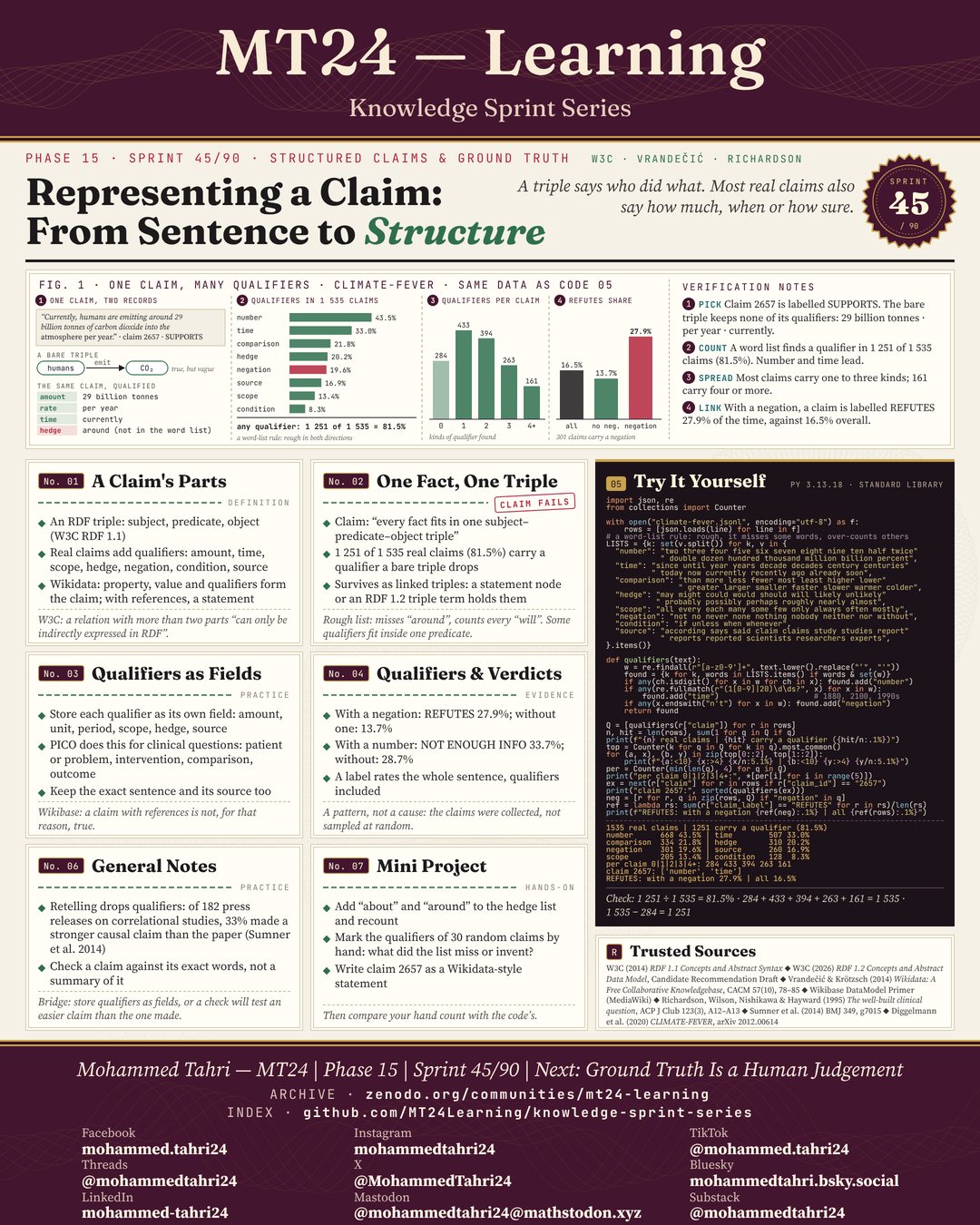

Fig. 1 in words
One claim, many qualifiers · CLIMATE-FEVER · same data as code 05
1 One claim, two records
- “Currently, humans are emitting around 29 billion tonnes of carbon dioxide into the atmosphere per year.” · claim 2657 · SUPPORTS
- a bare triple: humans → emit → CO₂ · true, but vague
- the same claim, qualified: amount 29 billion tonnes · rate per year · time currently · hedge around (not in the word list)
2 Qualifiers in 1 535 claims
- number 43.5% · time 33.0% · comparison 21.8% · hedge 20.2% · negation 19.6% · source 16.9% · scope 13.4% · condition 8.3%
- any qualifier: 1 251 of 1 535 = 81.5%
- a word-list rule: rough in both directions
3 Qualifiers per claim
- 0: 284 · 1: 433 · 2: 394 · 3: 263 · 4+: 161
- kinds of qualifier found
4 REFUTES share
- all 16.5% · no neg. 13.7% · negation 27.9%
- 301 claims carry a negation
01 A Claim's Parts Definition
- An RDF triple: subject, predicate, object (W3C RDF 1.1)
- Real claims add qualifiers: amount, time, scope, hedge, negation, condition, source
- Wikidata: property, value and qualifiers form the claim; with references, a statement
W3C: a relation with more than two parts “can only be indirectly expressed in RDF”.
02 One Fact, One Triple Claim fails
- Claim: “every fact fits in one subject–predicate–object triple”
- 1 251 of 1 535 real claims (81.5%) carry a qualifier a bare triple drops
- Survives as linked triples: a statement node or an RDF 1.2 triple term holds them
Rough list: misses “around”, counts every “will”. Some qualifiers fit inside one predicate.
03 Qualifiers as Fields Practice
- Store each qualifier as its own field: amount, unit, period, scope, hedge, source
- PICO does this for clinical questions: patient or problem, intervention, comparison, outcome
- Keep the exact sentence and its source too
Wikibase: a claim with references is not, for that reason, true.
04 Qualifiers & Verdicts Evidence
- With a negation: REFUTES 27.9%; without one: 13.7%
- With a number: NOT ENOUGH INFO 33.7%; without: 28.7%
- A label rates the whole sentence, qualifiers included
A pattern, not a cause: the claims were collected, not sampled at random.
05 Try It Yourself PY 3.13.18 · STANDARD LIBRARY
sprint45_representing_a_claim_from_sentence_to_structure.py
import json, re
from collections import Counter

with open("climate-fever.jsonl", encoding="utf-8") as f:
    rows = [json.loads(line) for line in f]
# a word-list rule: rough, it misses some words, over-counts others
LISTS = {k: set(v.split()) for k, v in {
  "number": "two three four five six seven eight nine ten half twice"
            " double dozen hundred thousand million billion percent",
  "time": "since until year years decade decades century centuries"
          " today now currently recently ago already soon",
  "comparison": "than more less fewer most least higher lower"
                " greater larger smaller faster slower warmer colder",
  "hedge": "may might could would should will likely unlikely"
           " probably possibly perhaps roughly nearly almost",
  "scope": "all every each many some few only always often mostly",
  "negation": "not no never none nothing nobody neither nor without",
  "condition": "if unless when whenever",
  "source": "according says said claim claims study studies report"
            " reports reported scientists researchers experts",
}.items()}

def qualifiers(text):
    w = re.findall(r"[a-z0-9']+", text.lower().replace("’", "'"))
    found = {k for k, words in LISTS.items() if words & set(w)}
    if any(ch.isdigit() for x in w for ch in x): found.add("number")
    if any(re.fullmatch(r"(1[0-9]|20)\d\ds?", x) for x in w):
        found.add("time")                     # 1880, 2100, 1990s
    if any(x.endswith("n't") for x in w): found.add("negation")
    return found

Q = [qualifiers(r["claim"]) for r in rows]
n, hit = len(rows), sum(1 for q in Q if q)
print(f"{n} real claims | {hit} carry a qualifier ({hit/n:.1%})")
top = Counter(k for q in Q for k in q).most_common()
for (a, x), (b, y) in zip(top[0::2], top[1::2]):
    print(f"{a:<10} {x:>4} {x/n:5.1%} | {b:<10} {y:>4} {y/n:5.1%}")
per = Counter(min(len(q), 4) for q in Q)
print("per claim 0|1|2|3|4+:", *[per[i] for i in range(5)])
ex = next(r["claim"] for r in rows if r["claim_id"] == "2657")
print("claim 2657:", sorted(qualifiers(ex)))
neg = [r for r, q in zip(rows, Q) if "negation" in q]
ref = lambda rs: sum(r["claim_label"] == "REFUTES" for r in rs)/len(rs)
print(f"REFUTES: with a negation {ref(neg):.1%} | all {ref(rows):.1%}")
Output, as printed on the image
1535 real claims | 1251 carry a qualifier (81.5%)
number      668 43.5% | time        507 33.0%
comparison  334 21.8% | hedge       310 20.2%
negation    301 19.6% | source      260 16.9%
scope       205 13.4% | condition   128  8.3%
per claim 0|1|2|3|4+: 284 433 394 263 161
claim 2657: ['number', 'time']
REFUTES: with a negation 27.9% | all 16.5%
Run it. sprint45_representing_a_claim_from_sentence_to_structure.py · versions, data and steps
Check: 1 251 ÷ 1 535 = 81.5% · 284 + 433 + 394 + 263 + 161 = 1 535 · 1 535 − 284 = 1 251
06 General Notes Practice
- Retelling drops qualifiers: of 182 press releases on correlational studies, 33% made a stronger causal claim than the paper (Sumner et al. 2014)
- Check a claim against its exact words, not a summary of it
Bridge: store qualifiers as fields, or a check will test an easier claim than the one made.
07 Mini Project Hands-on
- Add “about” and “around” to the hedge list and recount
- Mark the qualifiers of 30 random claims by hand: what did the list miss or invent?
- Write claim 2657 as a Wikidata-style statement
Then compare your hand count with the code’s.
R Trusted Sources
- W3C (2014) RDF 1.1 Concepts and Abstract Syntax
- W3C (2026) RDF 1.2 Concepts and Abstract Data Model, Candidate Recommendation Draft
- Vrandečić & Krötzsch (2014) Wikidata: A Free Collaborative Knowledgebase, CACM 57(10), 78–85
- Wikibase DataModel Primer (MediaWiki)
- Richardson, Wilson, Nishikawa & Hayward (1995) The well-built clinical question, ACP J Club 123(3), A12–A13
- Sumner et al. (2014) BMJ 349, g7015
- Diggelmann et al. (2020) CLIMATE-FEVER, arXiv 2012.00614