
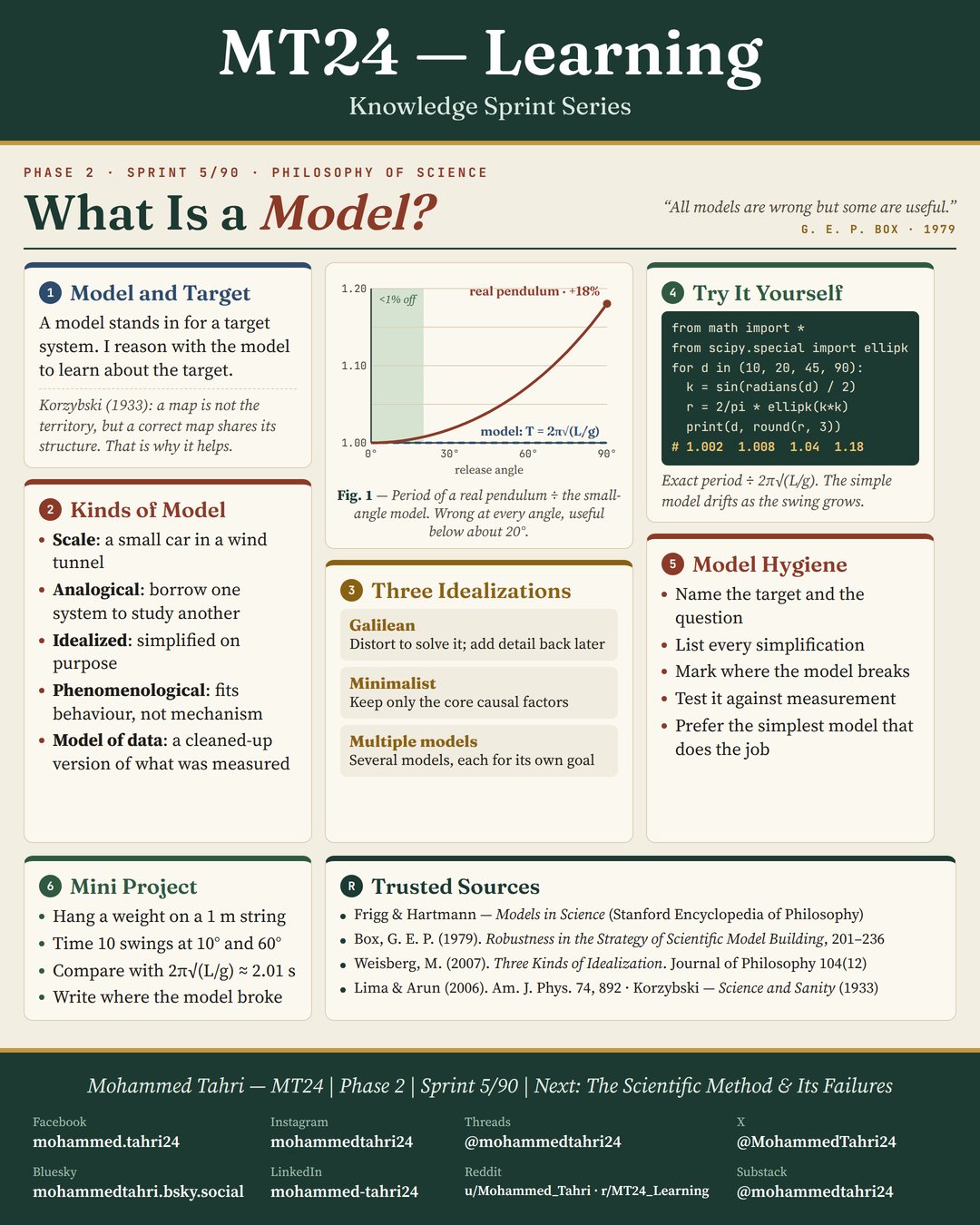
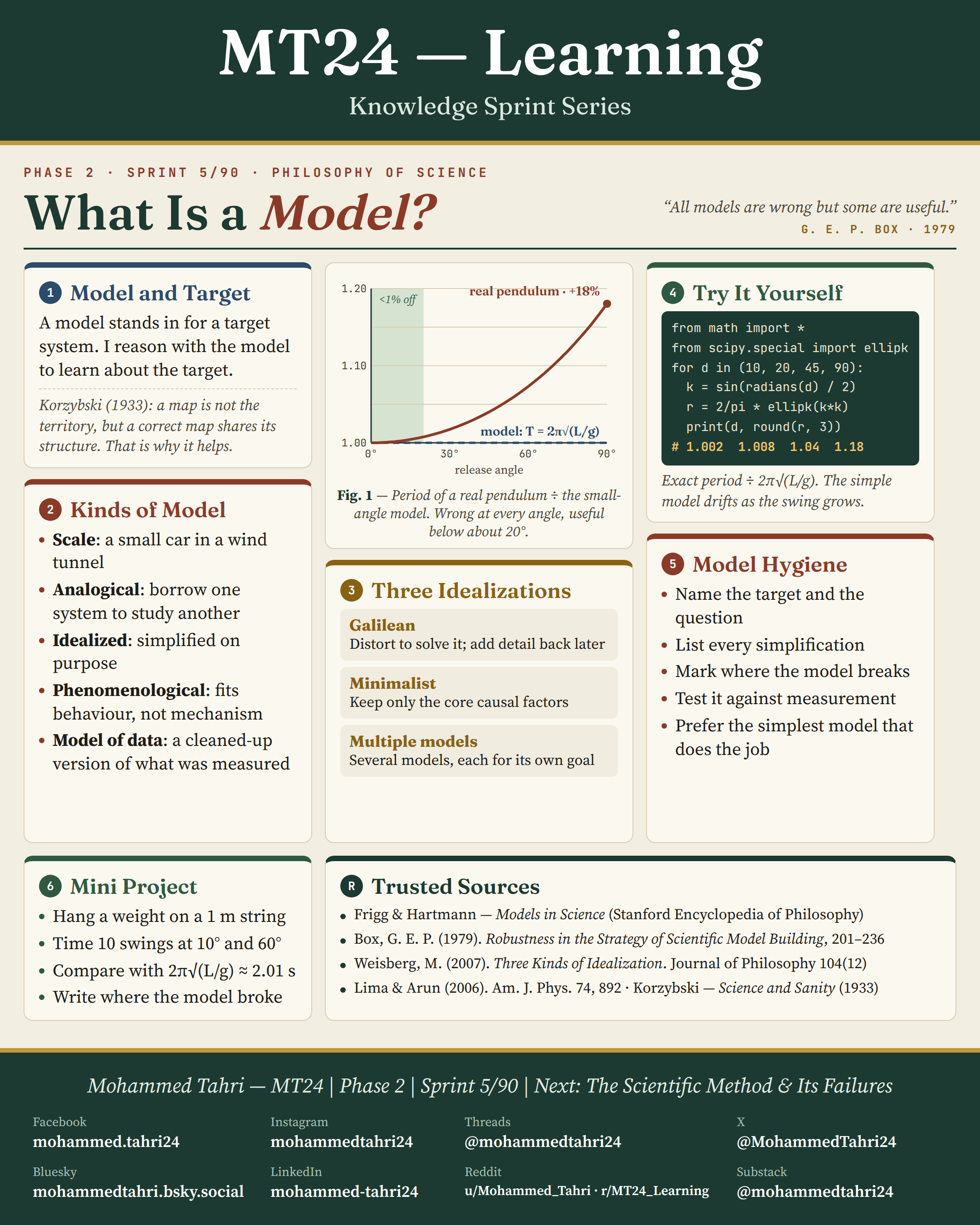
Fig. 1 in words
Period of a real pendulum ÷ the small-angle model. Wrong at every angle, useful below about 20°.
- y axis: 1.00 · 1.10 · 1.20
- x axis: release angle · 0° · 30° · 60° · 90°
- real pendulum · +18%: a curve rising from 1.00 at 0° to its end point at 90°
- model: T = 2π√(L/g): a dashed line at 1.00
- <1% off: a shaded band from 0° to about 20°
1 Model and Target
A model stands in for a target system. I reason with the model to learn about the target.
Korzybski (1933): a map is not the territory, but a correct map shares its structure. That is why it helps.
2 Kinds of Model
- Scale: a small car in a wind tunnel
- Analogical: borrow one system to study another
- Idealized: simplified on purpose
- Phenomenological: fits behaviour, not mechanism
- Model of data: a cleaned-up version of what was measured
3 Three Idealizations
- Galilean Distort to solve it; add detail back later
- Minimalist Keep only the core causal factors
- Multiple models Several models, each for its own goal
4 Try It Yourself
sprint05_what_is_a_model.py
from math import *
from scipy.special import ellipk
for d in (10, 20, 45, 90):
  k = sin(radians(d) / 2)
  r = 2/pi * ellipk(k*k)
  print(d, round(r, 3))
Output, as printed on the image
1.002 1.008 1.04 1.18Run it. sprint05_what_is_a_model.py · versions, data and steps
- Exact period ÷ 2π√(L/g). The simple model drifts as the swing grows.
5 Model Hygiene
- Name the target and the question
- List every simplification
- Mark where the model breaks
- Test it against measurement
- Prefer the simplest model that does the job
6 Mini Project
- Hang a weight on a 1 m string
- Time 10 swings at 10° and 60°
- Compare with 2π√(L/g) ≈ 2.01 s
- Write where the model broke
R Trusted Sources
- Frigg & Hartmann — Models in Science (Stanford Encyclopedia of Philosophy)
- Box, G. E. P. (1979). Robustness in the Strategy of Scientific Model Building, 201–236
- Weisberg, M. (2007). Three Kinds of Idealization. Journal of Philosophy 104(12)
- Lima & Arun (2006). Am. J. Phys. 74, 892
- Korzybski — Science and Sanity (1933)