
Fig. 1 in words
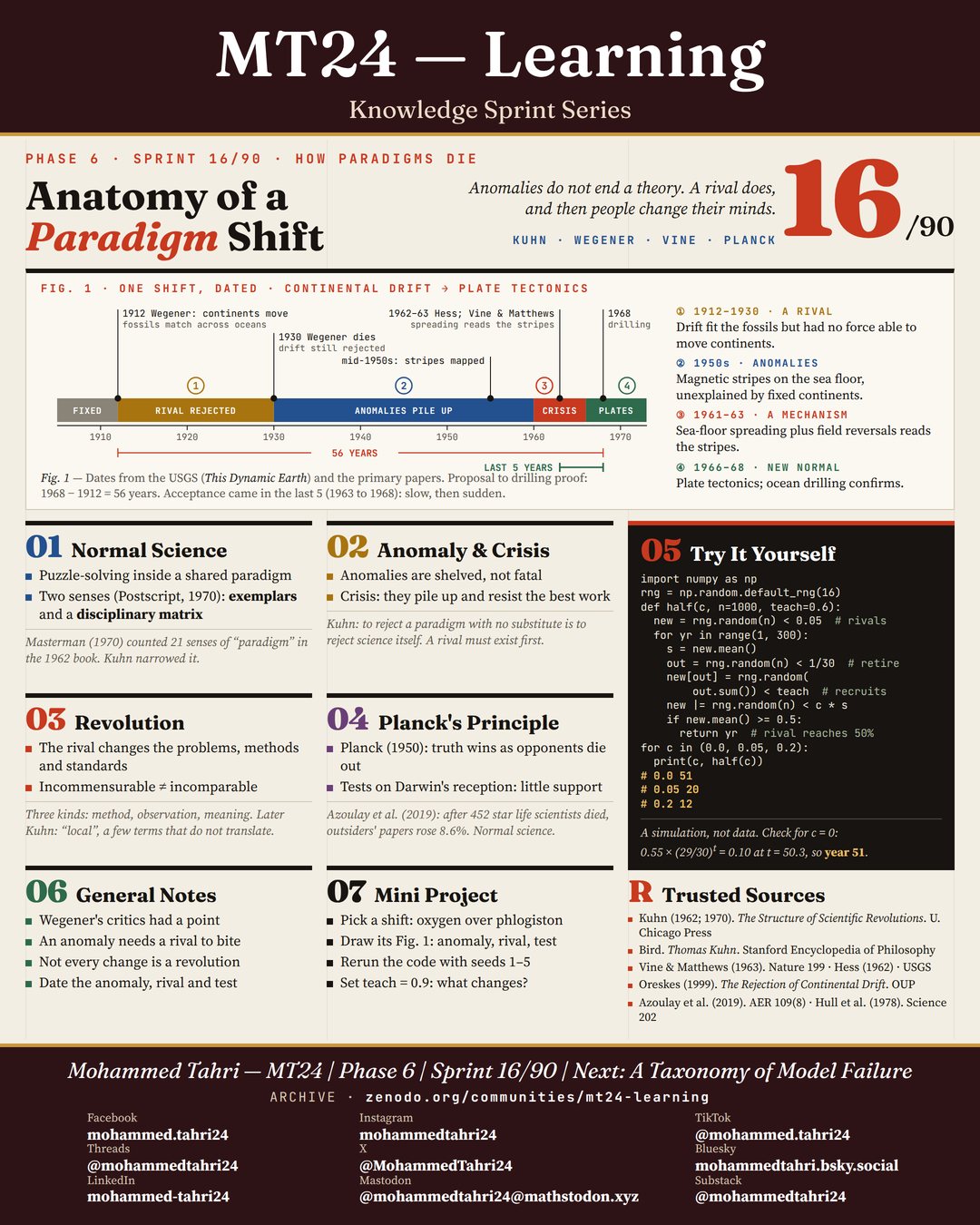
One shift, dated · continental drift → plate tectonics
- 1912 Wegener: continents move · fossils match across oceans
- 1930 Wegener dies · drift still rejected
- mid-1950s: stripes mapped
- 1962–63 Hess; Vine & Matthews · spreading reads the stripes
- 1968 drilling
- fixed → ① rival rejected → ② anomalies pile up → ③ crisis → ④ plates, on a time axis from 1910 to 1970
- 56 years from 1912 to 1968 · the last 5 years marked at the end
- Fig. 1 — Dates from the USGS (This Dynamic Earth) and the primary papers. Proposal to drilling proof: 1968 − 1912 = 56 years. Acceptance came in the last 5 (1963 to 1968): slow, then sudden.
01 Normal Science
- Puzzle-solving inside a shared paradigm
- Two senses (Postscript, 1970): exemplars and a disciplinary matrix
Masterman (1970) counted 21 senses of “paradigm” in the 1962 book. Kuhn narrowed it.
02 Anomaly & Crisis
- Anomalies are shelved, not fatal
- Crisis: they pile up and resist the best work
Kuhn: to reject a paradigm with no substitute is to reject science itself. A rival must exist first.
03 Revolution
- The rival changes the problems, methods and standards
- Incommensurable ≠ incomparable
Three kinds: method, observation, meaning. Later Kuhn: “local”, a few terms that do not translate.
04 Planck's Principle
- Planck (1950): truth wins as opponents die out
- Tests on Darwin's reception: little support
Azoulay et al. (2019): after 452 star life scientists died, outsiders' papers rose 8.6%. Normal science.
05 Try It Yourself
sprint16_anatomy_of_a_paradigm_shift.py
import numpy as np
rng = np.random.default_rng(16)
def half(c, n=1000, teach=0.6):
  new = rng.random(n) < 0.05  # rivals
  for yr in range(1, 300):
    s = new.mean()
    out = rng.random(n) < 1/30  # retire
    new[out] = rng.random(
        out.sum()) < teach  # recruits
    new |= rng.random(n) < c * s
    if new.mean() >= 0.5:
      return yr  # rival reaches 50%
for c in (0.0, 0.05, 0.2):
  print(c, half(c))
Output, as printed on the image
0.0 51
0.05 20
0.2 12
Run it. sprint16_anatomy_of_a_paradigm_shift.py · versions, data and steps
A simulation, not data. Check for c = 0: 0.55 × (29/30)ᵗ = 0.10 at t = 50.3, so year 51.
06 General Notes
- Wegener's critics had a point
- An anomaly needs a rival to bite
- Not every change is a revolution
- Date the anomaly, rival and test
07 Mini Project
- Pick a shift: oxygen over phlogiston
- Draw its Fig. 1: anomaly, rival, test
- Rerun the code with seeds 1–5
- Set teach = 0.9: what changes?
R Trusted Sources
- Kuhn (1962; 1970). The Structure of Scientific Revolutions. U. Chicago Press
- Bird. Thomas Kuhn. Stanford Encyclopedia of Philosophy
- Vine & Matthews (1963). Nature 199
- Hess (1962)
- USGS
- Oreskes (1999). The Rejection of Continental Drift. OUP
- Azoulay et al. (2019). AER 109(8)
- Hull et al. (1978). Science 202