
Abstract
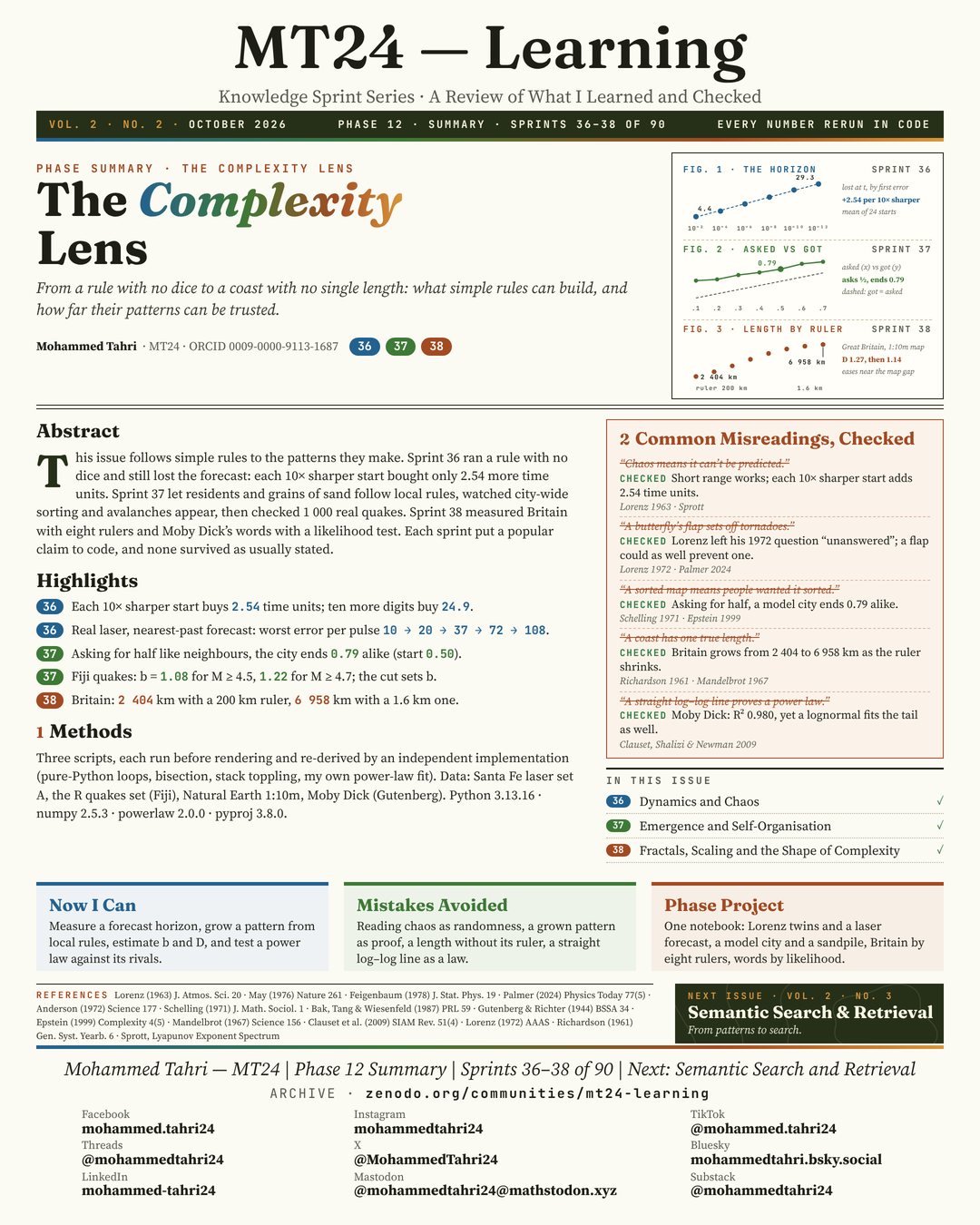
This issue follows simple rules to the patterns they make. Sprint 36 ran a rule with no dice and still lost the forecast: each 10× sharper start bought only 2.54 more time units. Sprint 37 let residents and grains of sand follow local rules, watched city-wide sorting and avalanches appear, then checked 1 000 real quakes. Sprint 38 measured Britain with eight rulers and Moby Dick’s words with a likelihood test. Each sprint put a popular claim to code, and none survived as usually stated.
Highlights
- 36Each 10× sharper start buys 2.54 time units; ten more digits buy 24.9.
- 36Real laser, nearest-past forecast: worst error per pulse 10 → 20 → 37 → 72 → 108.
- 37Asking for half like neighbours, the city ends 0.79 alike (start 0.50).
- 37Fiji quakes: b = 1.08 for M ≥ 4.5, 1.22 for M ≥ 4.7; the cut sets b.
- 38Britain: 2 404 km with a 200 km ruler, 6 958 km with a 1.6 km one.
Figures in words
1 Fig. 1 · The horizon Sprint 36
- lost at t, by first error
- six points on a dashed line, first error 10⁻² · 10⁻⁴ · 10⁻⁶ · 10⁻⁸ · 10⁻¹⁰ · 10⁻¹²: 4.4 at the first, 29.3 at the last
- +2.54 per 10× sharper
- mean of 24 starts
2 Fig. 2 · Asked vs got Sprint 37
- asked (x) vs got (y)
- seven points on a solid line for asks .1 to .7, all above the dashed line; 0.79 at .5
- asks ½, ends 0.79
- dashed: got = asked
3 Fig. 3 · Length by ruler Sprint 38
- Great Britain, 1:10m map
- eight points from ruler 200 km to 1.6 km: 2 404 km at the first, 6 958 km at the last
- D 1.27, then 1.14
- eases near the map gap
1 Methods
Three scripts, each run before rendering and re-derived by an independent implementation (pure-Python loops, bisection, stack toppling, my own power-law fit). Data: Santa Fe laser set A, the R quakes set (Fiji), Natural Earth 1:10m, Moby Dick (Gutenberg). Python 3.13.16 · numpy 2.5.3 · powerlaw 2.0.0 · pyproj 3.8.0.
2 Common Misreadings, Checked
“Chaos means it can’t be predicted.”Checked Short range works; each 10× sharper start adds 2.54 time units.
Lorenz 1963 · Sprott
“A butterfly’s flap sets off tornadoes.”Checked Lorenz left his 1972 question “unanswered”; a flap could as well prevent one.
Lorenz 1972 · Palmer 2024
“A sorted map means people wanted it sorted.”Checked Asking for half, a model city ends 0.79 alike.
Schelling 1971 · Epstein 1999
“A coast has one true length.”Checked Britain grows from 2 404 to 6 958 km as the ruler shrinks.
Richardson 1961 · Mandelbrot 1967
“A straight log–log line proves a power law.”Checked Moby Dick: R² 0.980, yet a lognormal fits the tail as well.
Clauset, Shalizi & Newman 2009
In This Issue
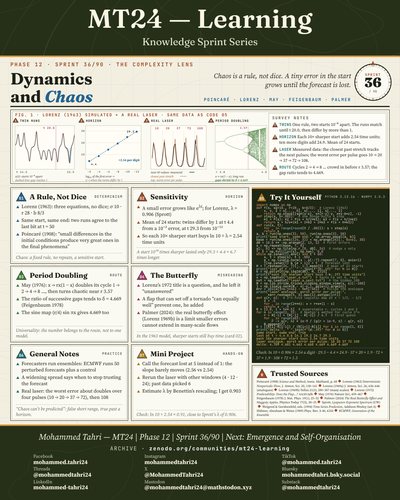 Dynamics and ChaosChaos is a rule, not dice. A tiny error in the start grows until the forecast is lost.
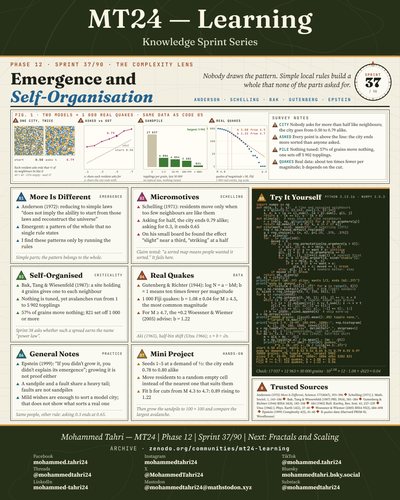 Emergence and Self-OrganisationNobody draws the pattern. Simple local rules build a whole that none of the parts asked for.
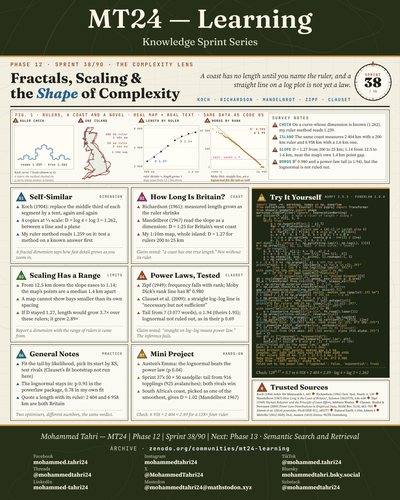 Fractals, Scaling and the Shape of ComplexityA coast has no length until you name the ruler, and a straight line on a log plot is not yet a law.
Now I Can
Measure a forecast horizon, grow a pattern from local rules, estimate b and D, and test a power law against its rivals.
Mistakes Avoided
Reading chaos as randomness, a grown pattern as proof, a length without its ruler, a straight log–log line as a law.
Phase Project
One notebook: Lorenz twins and a laser forecast, a model city and a sandpile, Britain by eight rulers, words by likelihood.
R References
- Lorenz (1963) J. Atmos. Sci. 20
- May (1976) Nature 261
- Feigenbaum (1978) J. Stat. Phys. 19
- Palmer (2024) Physics Today 77(5)
- Anderson (1972) Science 177
- Schelling (1971) J. Math. Sociol. 1
- Bak, Tang & Wiesenfeld (1987) PRL 59
- Gutenberg & Richter (1944) BSSA 34
- Epstein (1999) Complexity 4(5)
- Mandelbrot (1967) Science 156
- Clauset et al. (2009) SIAM Rev. 51(4)
- Lorenz (1972) AAAS
- Richardson (1961) Gen. Syst. Yearb. 6
- Sprott, Lyapunov Exponent Spectrum